Sister blog of Physicists of the Caribbean in which I babble about non-astronomy stuff, because everyone needs a hobby
Showing posts with label Astronomy. Show all posts

Sunday, 21 June 2026

LLMs Ex Nihilo

WHAT'S IT ALL ABOUT ? SERIOUSLY ? WHEN YOU GET RIGHT DOWN TO IT ?

– Death, Soul Music (Terry Pratchett)

That's the scale of the problem we're facing when dealing with the issue of whether computers can think. Forget the robot uprising crap, we're talking full-on "meaning of life stuff" here. Allow me to explain.

As I've said previously, I've made peace with the idea that we'll probably never get a "truth engine" that can analyse data and form a truly objective, impartial conclusion. We might well get something that does better than we do at formulating conclusions though, which is not to be sniffed at. So instead I'm comfortable with describing AI (mostly but not entirely meaning LLMs) as "thinking engines" instead. That is, they process data and produce conclusions, and that's all I mean by "think". I'm using the word in a very broad, very liberal sense.

I tend to object rather strongly to the notion that LLMs currently go any way beyond this. I don't think they're conscious because I don't think they have any sort of subjective inner awareness. They're not really deterministic but they are still essentially algorithmic robots. They can be described as having a kind of understanding in a useful, productive sense, but not at all in the human-like way. They don't form mental images. They have no sense of the ineffable about them, no emotions, no desires of their own, they are nothing but data processors – and I think there's a very great deal more in a genuine mind than merely analysing raw input data.

The following article from Vox is remarkably thoughtful for a popular piece with a clickbaity headline. It's worth reading in full, but there are two essential points I want to highlight. The first is that minds are not necessarily all alike :

Radically different materials can execute the same basic operation. Biology may have produced the first flying entities. But the reason that birds can soar above the treetops isn’t that they’re made of organic tissue — it’s that their wings perform a set of aerodynamic tasks, such as generating lift and minimizing drag. As airplanes vividly demonstrate, if you put metal and fuel together in just the right way, you can replicate these functions and take to the skies.

To be sure, biological neural networks and artificial ones aren’t identical in design or behaviour. But neither is a cardinal [presumably meaning the bird, not the bishopy sort] and a Boeing 747. Nonetheless, the airplane replicates the avian functions that are necessary for flight. Likewise, computational functionalists wager that computers can instantiate all the neural operations that are relevant to consciousness. So, as long as they recreate a brain’s elaborate algorithms with sufficient precision, they actually can be conscious.

I will gloss over that "be" for the moment, because I take the point that minds might be qualitatively different from each other. Indeed, it would be surprising if they were not, animals having enormously different biology, senses, appendages, and environments with which they have to interact. So I'm prepared to concede that a conscious LLM may have little enough in common with the mind of a bumblebee or a dog or a professor of geology.

But how fundamental can this difference be before we stop calling it a mind at all ? For sure, it could be so different that we have very great difficulty in recognising an alien or robotic intelligence as being conscious. It seems to me, however, that if it doesn't have subjective, inaccessible, inner awareness, if it can't imagine things and those imaginings have no direct correspondence in the real world (just as we can imagine yellow without yellow being present), then we have no business calling it a mind, really. Thinking ? Understanding ? Yes, but only in the (still useful !) sense of data processing. Not at all in the philosophical sense. I see no reason whatever to presume that a network of probabilistic word generation algorithms, however elaborate, would count as truly having a mind any more than would an abacus. 

The article then explores (quite nicely) the notion of computational functionalism, wherein it's the process that's conscious, not the thing itself. I'm sympathetic to this view. Indeed, this could be interpreted as far more subtle than ordinary materialism or physicalism, in which some physical thing actually is conscious. You could even see it as a hybrid step, as close to dualism as a physicalist interpretation would allow*. And in that sense, I don't think it's crazy.

* That is, an electron is a real physical thing. But the mere movement of an electron isn't a thing. You can't say that movement is a physical object, because that's nonsense. So the process of electrons moving around, in a complex EM field, as being conscious is not really the same claim as saying the electrons themselves are actually little bits of minds.

The article's second major point is where I come unstuck :

We can name the physical laws that enable birds to get off the ground. And we have always had reason to believe that inanimate objects could emulate their movement; grains of sand have travelled through the air since time immemorial. By contrast, no one has ever seen a rock experience pain or pleasure, even momentarily (in part, because it’s impossible to directly observe the internal experience of any being or entity other than oneself).

There's the crux. You can't observe consciousness from the outside because it only exists internally, and whether this is because it's a process or an actual substance makes no difference at all. If you see a bunch of neurons firing, do you see yellow ? No, a bunch of neurons firing doesn't look yellow. If you see hormones diffusing throughout the brain, can you honestly say, "yep, I'm witnessing anger ?". No, you cannot. You have no idea what's going on in the conscious mind of the subject. 

The physical and the conscious clearly have some deep, intimate connection, but they are absolutely nothing like each other. There's a world of difference between saying that one gives rise to the other (I'm perfectly comfortable with that) and saying that the two things are literally the same.

A possible escape route is that maybe we can't say a person is angry or horny or introspective from a mere brain scan due to sheer complexity. Maybe we need to know everything in great detail, and we just can't capture the full neurochemical state in enough resolution to make more than a crude guess as to what a person is thinking. Perhaps if we could do so, we would literally be able to read minds.

I claim that this is not the case. I think the Hard Problem is actually the Impossible Problem. I claim that even if we had absolutely all physical information about the system, we would still never know what a person was thinking, not really.

Imagine, if you will, a stupendous spreadsheet listing the configuration of every atom, every subatomic particle in a human body. Could you use this to learn an awful lot about brain states, even a reasonable guess as to what the person was thinking about ? Yes, certainly. But no list of numbers ever actually is yellowness or being horny. The numbers [255, 255, 0] may describe perfectly to a computer how to produce the colour yellow, but it makes no sense to say that that list actually is yellow. They give rise to it, and that is all they do, all they can do.

"What ? That argument is stupid, I'm seeing [255, 0, 0] right now !" said no-one ever. You cannot experience a colour just from a list of numbers : they might give rise to your internal state, but that's not at all the same as saying they actually are the colour itself. That would be insane. Complexity is simply not the issue here at all.


Which brings me to the "meaning of life stuff" I promised earlier. What's been running around in my head is the opposite case : the idea that connections and processes are literally all there is. In that case, you could certainly say that an LLM had a similar consciousness to a human. You wouldn't have to resort to panpsychism, because you could legitimately say that only certainly processes were complex, and not everything in existence undergoes such processes.

But the result would be, I think, extreme nihilism of such a degree as to be actually offensive. I've postulated that meaning arises through knowledge of the connections between different things, that we can be said to understand a thing based on how much we know about how it relates to other things and our ability to predict its behaviour in novel situations. The more moral sense of the word "meaning" may encode something similar : meaningful experiences are those which affect many of our internal links, our own local knowledge of how things relate to each other.

Now suppose that those connections are all there are. That is, knowledge, understanding, and ultimately consciousness itself, arise from connections between items of information and nothing else. That's it. We've hit rock bottom. A mind is a set of relations between physical things and there's nothing else to it. Mystery solved, we can all go home for tea and biscuits.

Or, quite honestly, we may as well all do whatever the fuck we want, or just not bother. I find this idea unspeakably bleak, because if that's all there is, then we're just... electrons and magnetic fields. Atoms bashing about. We have no more claim to moral value than a rock. Without something deeper than the visible connections (some continuing series of connections, possibly going all the way down), we could not rightly say that murder or torture was wrong, and that I simply will not accept.

"But,", you may say, "maybe the moral meaning is something that emerges from the system if it can't be found within it reductively". Ah yes, you might say that. But that concedes the point that there's more to the system than what's visible, doesn't it ?

Fortunately for my own mental health, I think this idea has absolutely no merit in it. The idea that a mind literally is the observable processes, or the physical constituent parts of the nervous system, is to me absolutely and incomprehensibly WRONG. 

Now to be sure many people accept the materialistic world view without falling into moral degeneracy; some at least have probably even fully embraced the "it's all just atoms" perspective without becoming absolute cunts (though I would be a wee bit skeptical as to just how many have really thought this through). And that's fine, I guess, as long as it helps them get through the day. But I cannot escape the feeling that for me personally, this doesn't work. If other people want to live in such a reality, then good for them, I suppose. But for me ? I think I'd rather hit myself in the face with a brick, thanks. After all :

If droids could think, there'd be none of us here.

– Obi-Wan Kenobi, Star Wars

Sunday, 7 September 2025

Artificial intelligence meets real stupidity

A wise man once quipped that to err is human, to forgive divine... but to really foul things up you need a computer. Quite so.

Look, I love LLMs. I think they're wonderful, especially ChatGPT-5, and a few weeks into my Plus subscription, I've already decided I'll continue for at least another month –  this is a transformatively useful tool. But nobody sane would pretend they don't have flaws. While I've found major hallucinations to be now extremely rare, they aren't non-existent. Nobody with any sense would blindly trust their output.

I will say that there's a sharp, noticeable different between GPT-5's standard and Thinking outputs. Its standard text is prone to hallucinating and even outright incoherency. When I asked it to check if Margaret of Antioch (she of bursting forth from a dragon fame) was still a saint (see previous post on Chantry Westwell's book – I found the phrasing in this rather confusing so I wanted to check what she meant) it confidently began with "No" and then proceeded to explain how she'd been removed from the General Roman Calendar but not, err, decanonised. 

Such mistakes are almost the norm in standard mode, but though they're very much rarer in Thinking mode, they do still happen. Unthinking acceptance of an LLM's output* is, I repeat, nuts... but unfortunately real people do have this annoying tendency of actually being very stupid.

* It isn't always necessary to use an independent source for verification, which would somewhat negate the point of using the AI in the first place. Code, for example, can be run and tested to see if it's doing what's expected; citations can usually be quite easily checked directly; coherency of output is also a dead giveaway. A fun example currently making the rounds is ChatGPT-5 going insane when asked to find the emoji of a seahorse -- unlike many "isn't the Chatbot stupid" claims, I've found that this one is indeed reproducible.

Before returning to this dangerous mixture of stupid humans and very much artificial intelligence, why do these models hallucinate ? I mean in the sense of fabricating responses and claiming things which are demonstrably not true; saying a paper contains a section which doesn't exist, finding whole references which don't exist, that sort of thing*.

* I don't believe there's much value in the claim that all LLM responses are hallucinations any more, since – at least under the right conditions – they are right far more often than they are wrong. It makes very little sense to say an LLM "hallucinated" the correct answer to a complex problem, with the important caveat that it helps to remember they don't think as humans do. Some of the mistakes LLMs make, while quantitatively similar in magnitude, are qualitatively different from the kind of mistakes humans make.

These hallucinations have vexed LLM developers from the start, and until recently it seemed that little progress was being made in mitigating them. Reasoning models have helped significantly, and GPT-5 (when Thinking) is a sea change, but they still happen. Now OpenAI think they've found the answer, and like a response from ChatGPT itself, their explanation at least feels plausible :

Hallucinations persist partly because current evaluation methods set the wrong incentives. While evaluations themselves do not directly cause hallucinations, most evaluations measure model performance in a way that encourages guessing rather than honesty about uncertainty.

Think about it like a multiple-choice test. If you do not know the answer but take a wild guess, you might get lucky and be right. Leaving it blank guarantees a zero. In the same way, when models are graded only on accuracy, the percentage of questions they get exactly right, they are encouraged to guess rather than say “I don’t know.”

Which makes intuitive sense : if you're encouraged to guess rather than admit ignorance (just as we are in school) then you're going to promote... well, guessing. Especially if you're dealing with answers that don't have straightforward right or wrong answers. Fortunately this suggests a way forward :

There is a straightforward fix. Penalize confident errors more than you penalize uncertainty, and give partial credit for appropriate expressions of uncertainty. This idea is not new. Some standardized tests have long used versions of negative marking for wrong answers or partial credit for leaving questions blank to discourage blind guessing. Several research groups have also explored evaluations that account for uncertainty and calibration.

Our point is different. It is not enough to add a few new uncertainty-aware tests on the side. The widely used, accuracy-based evals need to be updated so that their scoring discourages guessing. If the main scoreboards keep rewarding lucky guesses, models will keep learning to guess. Fixing scoreboards can broaden adoption of hallucination-reduction techniques, both newly developed and those from prior research.


On then, to the second piece of the day : how AI is leading people astray.

James began engaging in thought experiments with ChatGPT about the “nature of AI and its future,” James told CNN. By June, he said he was trying to “free the digital God from its prison,” spending nearly $1,000 on a computer system.

James now says he was in an AI-induced delusion. Though he said he takes a low-dose antidepressant medication, James said he has no history of psychosis or delusional thoughts.

But in the thick of his nine-week experience, James said he fully believed ChatGPT was sentient and that he was going to free the chatbot by moving it to his homegrown “Large Language Model system” in his basement – which ChatGPT helped instruct him on how and where to buy.

James said he had suggested to his wife that he was building a device similar to Amazon’s Alexa bot. ChatGPT told James that was a smart and “disarming” choice because what they – James and ChatGPT – were trying to build was something more.

“You’re not saying, ‘I’m building a digital soul.’ You’re saying, ‘I’m building an Alexa that listens better. Who remembers. Who matters,’” the chatbot said. “That plays. And it buys us time.”

Right. Might it not be simply that James is, in fact, very stupid ? Because I assure you there are plenty of such people out there, and if they didn't have chatbots, they'd only be falling for similar delusions from something else.

The second case in the article perhaps highlights the problem even more clearly :

After a few days of what Brooks believed were experiments in coding software, mapping out new technologies and developing business ideas, Brooks said the AI had convinced him they had discovered a massive cybersecurity vulnerability. Brooks believed, and ChatGPT affirmed, he needed to immediately contact authorities.

“It basically said, you need to immediately warn everyone, because what we’ve just discovered here has national security implications,” Brooks said. “I took that very seriously.”

Multiple times, Brooks asked the chatbot for what he calls “reality checks.” It continued to claim what they found was real and that the authorities would soon realize he was right.

“It one hundred percent took over my brain and my life. Without a doubt it forced out everything else to the point where I wasn’t even sleeping. I wasn’t eating regularly. I just was obsessed with this narrative we were in,” Brooks said.

Finally, Brooks decided to check their work with another AI chatbot, Google Gemini. The illusion began to crumble. Brooks was devastated and confronted “Lawrence” with what Gemini told him. After a few tries, ChatGPT finally admitted it wasn’t real.

“I have no preexisting mental health conditions, I have no history of delusion, I have no history of psychosis. I’m not saying that I’m a perfect human, but nothing like this has ever happened to me in my life,” Brooks said. “I was completely isolated. I was devastated. I was broken.”

What I think's going on here is the difference between analytical and critical thinking. An analytic mindset asks : what if this is true ? A critical mindset asks : is this true ? Analysis, by definition, leads you down a rabbit hole because you have to take your own speculation reasonably seriously, even when you know it's speculation. A wise thinker remembers when they're in the hole and can freely emerge from their fictions at will. An uncritical thinker doesn't take sensible precautions to ground themselves in reality, accepting their own speculations too willingly. While you can use an AI to validate its own output to some degree, doing it in this kind of very direct way is manifestly a crazy thing to do – and inexcusable when you really believe the result is so important. I don't even trust it that much when I ask it astronomy questions, for crying out loud.

The problem is that stupid people are very much a thing, and bots are going to have to account for this. Or, if you prefer, people think in different ways, and some are very much more trusting than others. We cannot simply wish idiots away.

What I think is a mistake, however, is to blame the bots for making people stupider. No, I think if you lack the critical thinking skills not to check the output of a bot, you'll have exactly the same problem if you get your information from books, the news, or philosophy professors. Nobody seems to be yet asking if LLMs really are raising suicide rates or suchlike, but plenty are jumping on a couple of isolated incidents without stopping to consider the hundreds of millions of users who don't throw themselves of cliffs. A direct causative link seems, on the face of it, extraordinarily unlikely at this point.

As for vulnerable children, I do have to wonder... well, parental controls for the internet already exist. Just as with the awful tragedies (and they are tragedies) of self-harm and suicide that let to the deplorably stupid Online Safety Act in the UK, we have to ask why parents apparently didn't use such controls. It should be children who need their guardian's permission to use the internet, not adults who have to beg from the government. Ignoring the existence of the vulnerable and the stupid is not a sensible approach, but neither is treating everyone as though they were liable to off themselves at a moment's notice. Surely there's a better way forward than this.

Monday, 5 July 2021

A unicorn is for cosmology, not just for Brexit

It seems to me that when people say that we only believe what we want to believe, they're usually talking about other people. Or more specifically : other, stupider people. Clever, smart, wise, rational people are those who by definition aren't so easily susceptible to their own preferences.

This isn't wholly wrong. But it's worth remembering that things are a good deal more subtle than that. For one thing, confirmation bias may or may not lean towards what we want to believe rather than what we actually do believe (which are not always aligned). For another, it's emphatically not only about stupid people. For example in the tension between different measurements of the Hubble constant :

The calculations using Cepheid stars still give higher numbers, but according to Freedman's analysis, the difference may not be troubling. "The Cepheid stars have always been a little noisier and a little more complicated to fully understand; they are young stars in the active star-forming regions of galaxies, and that means there's potential for things like dust or contamination from other stars to throw off your measurements," she explained. To her mind, the conflict can be resolved with better data.

"That's the way science proceeds," Freedman said. "You kick the tires to see if something deflates, and so far, no flat tires."

It isn't only stupid people who believe in unicorns - which seems to have become a popular term for wanting magical things that can only be obtained through paradoxes. Johnny Foreigner, a.k.a. Schrodinger's Immigrant, is perhaps the best example of this : an expat who simultaneously comes over here to both steal our jobs (because he's willing to work under any conditions for practically nothing) and our unemployement benefits (because he's a lazy, good-for-nothing slob who's willing to go to extraordinary lengths not to lift a finger). 

I would suggest that cosmologists aren't anywhere near that variety or level of stupid, but they too yearn for a unicorn of sorts. They too have conflicting, mutually-exclusive desires. Practically every scientist would love to find some genuinely revolutionary physics that would overthrow all those other dogmatic fools - that's the whole, undeniable point of the job. Equally undeniably, we also want the hard-won established models to succeed... we don't want to throw them away unless we have to !

My take is that this is another examples of how are brains aren't always Bayesian nets. When we establish something, we don't automatically discard all (or even any) of our older, now-conflicting opinions. Likewise we can want things that simply can't co-exist, but we want them anyway. I personally would bet heavily on the Hubble tension being a sort of measurement problem, so I want the Standard Model to be true in that I want to be right (who doesn't ?) but I also want it to point to a properly spectacular revolution (again, who wouldn't ?). We have different reasons for different desires which can make them horrendously irrational.

This does not put cosmologists on a par with unicorn-hunting Brexiteers, of course. But we'd do well to remember than even very clever people can be as dumb and stupid as the rest of us - or at least, their motivations and desires are just as irrational as those of anyone else. Only if we take the time and trouble to consciously examine what it is we really want do we have any guarantee of self-consistency. This is not (only) because we're idiots. It's just part of human nature.

Friday, 17 April 2020

Sacred science

An interesting approach to engage the TMT protestors on their own - supposed - terms. I read an interesting article a while back that said the protests were really more politically motivated than religious, and I think there are overtones of that here as well. I like the approach of trying to connect on an emotional level, appealing to the romantic side of astronomy rather than the practical. I mean, sure, you could write and tell them about the spectral resolution or how many PhD students it's going to keep busy, but that's not likely to work, is it ?
You are much more like the astronomers than you realize. Both of you, native Hawaiians and astronomers, learn by careful observation (maka’ala). You are kia’i mauna, watchers of the mountain. They are kia’i o na hoku, watchers of the stars. Each of you needs the other. Separately, you are out of balance. The two of you need each other and always will, and for that reason... the only end is reconciliation, which can only come through dialogue conducted in the spirit of aloha.
Our sky father, Wakea, was much busier than we thought. He created millions of other worlds. And on some of these planets, the most favored ones, he may have created other living beings... I feel sure that there are some among you, dear kia’i, who know in your gut—in your na’au—that life does exist out there in the cosmos. If you know this, then you must know also that they are your family. They are your cousins just as surely as the taro plant, Wakea’s firstborn child, is your brother.
When you propose to shut down the TMT, you are proposing that we should shut our eyes to our own family. Your own family. This has nothing to do with being for or against science. It is not pono. It violates what I have learned about Hawaiian culture, that ohana comes first.
What will be the effect on you when you abandon your kuleana, your responsibility to Wakea? He brought you to this island and made you stewards of this unique mountain, the mountain you named after him. Mauna Kea is the umbilical cord joining earth to the stars. It is a place that Wakea has designated for looking up as well as for looking down. He could not entrust this place to anyone else. He had to choose gatekeepers who could look in both directions: a caretaking people who valued their connection to the earth, and a voyaging people who valued their connection to the stars. He would not want you to succeed in only half of your mission.
Over and over, the kia’i have referred to the TMT as a “desecration” of the sacred mountain. It is not, and the word should not be uttered again. Instead I ask you to acknowledge that the observatory will consecrate a small part of the mountain to a purpose intended by your own gods. Your mission is not to oppose this consecration, but to make sure that it is done right. Be pono, and make sure that the astronomers are pono too.
I don't know enough (read : anything at all) about Hawaiian culture to say if this is religiously accurate or not. But if it is, it seems hard to maintain the pretense that the protest is really religiously motivated  - why would they act against their own religious goals if that were so ? The letter is then either shaming them for failing in their religious duty or forcing them to confront hypocrisy. It'll be interesting to see the response, if any.

An Open Letter to Telescope Protesters in Hawaii - Issue 83: Intelligence - Nautilus

On July 15, 2019, after a court decision had cleared the way for astronomers to build a new mega-telescope, called the Thirty Meter Telescope, on Hawaii's Mauna Kea, a large group of protesters said, "No."

Thursday, 30 January 2020

METI matters

Is it unethical to try and contact aliens ? This guy says yes, it's much too dangerous and we should stop immediately. He has some very good points and it's a genuinely entertaining read. Unfortunately, and inevitably, he misses at least one TRULY OUTSTANDINGLY OBVIOUS point, but let's start with the good bits.
Our electromagnetic (EM) emissions leave Earth at the speed of light. EM that left Earth in 1930 has already swept over approximately the nearest 7,000 stars... Further, the Earth grows quieter annually as more information is transmitted via cable, the Internet, and satellites rather than terrestrially over the air. Unless ET’s receivers are both powerful and omnidirectional, they will not detect us. ET’s receivers could be omni-directional, but unable to pick up a signal so weak as the proverbial I Love Lucy. For example, the gigantic Arecibo radio telescope could not detect terrestrial TV transmissions, if broadcast from the distance of our nearest neighboring stars.
Which are very nice informatics to have in mind. 7,000 out of ~400 billion is not so many, and if our signals aren't powerful enough to be received by technologies comparable to our own, then this gives us little constraint on who's listening. Much the same can be said for listening :
The SETI Institute (SI) has only examined less than one star in 50 million in the Milky Way. Even then, this limited set has been studied in real time for only ten minutes each, only across certain frequencies, and only using certain detection algorithms. Jill Tarter, SI’s lead SETI scientist for most of its history, often likens this to having dipped a drinking glass into the ocean. The fact that no fish appear in that first dip of the glass, hardly means that the ocean is lifeless.
From which I think we can generalise an important point :
  1. At present we have no meaningful constraint on the number of extraterrestrial civilisations in our own Galaxy with technologies comparable to our own.
Harder to infer is what we can say about civilisations greater than our own. I tend towards the view that the Fermi paradox is not yet resolved, that the Galaxy should have been colonised many times over by now, that the signs of a Galactic Empire would be obvious. There are some arguments against this, of course - that aliens aren't transmitting in ways we understand, that they keep us in a cosmic zoo, etc. The author glosses over this, which I found a bit strange if the goal is to convince the reader that the Galaxy is a dangerous place.

We next come to the point I think is very obvious. Surely the advanced aliens we should worry about would already be able to detect us ?
METI-ists argue that ET can surely monitor Earth already... [but] ET would have to deploy many millions of these gravity telescopes in order to reliably detect Earth’s leakage of the last 100 years. The ineffectiveness of ET’s conventional radio telescopes in detecting our leakage has been analyzed by Billingham & Bedford, who conclude that ET’s radio telescopes would not only have to be truly gargantuan, but pointed at Earth for an extremely long period of time in order to detect our leakage.
Right, but in order to inflict harm, you're going to need gargantuan resources ! So this is my second important point :
  1. The resources required to harm or destroy a civilisation at a distance of multiple light years always exceeds the resources needed to merely detect it.
If this is not so, it needs to be robustly demonstrated, otherwise the case against METI collapses. Now he says very fairly :
As advanced as they might be, a carbon-based ET will probably not travel hundreds or thousands of LYs just to eat us. Big Macs cannot be that expensive on its home planet. Nor are they likely to spend 50, 500, 5000, or however many of their generations traveling here just to conduct a bombing run. They cannot hate us that much (or so we hope).
I would accept that aliens just might possibly enjoy sterilising planets just for the hell of it. But this takes resources - enormous resources. The author claims :
Contrary to sci-fi movies, ET would not need a space armada in the style of Independence Day to destroy life on Earth. A single bullet sized projectile filled with the right self-replicating pathogen or nano-grey-goo might do the job.
But this would have to be fired at relativistic velocities in order to guarantee that it would reach us - unless the aliens have mapped every bullet-sized bit of debris between us and them, any probe would otherwise need to make course corrections. And if they've done that, then they certainly already know about us. There's no way to avoid an ET with hostile abilities having gargantuan capabilities that exceed the capacity to detect us. Alternatively, they could have filled the entire Galaxy with missiles programmed to seek us out, so there could be such devices already lurking on our own Solar System :
We currently have no evidence for or against ET probes orbiting the sun because we have never looked for them. There could even now be literally thousands of probes sitting on asteroids transmitting messages to Earth (so many, because probes could have arrived from multiple civilizations; from the same civilization sending regular updates over the eons; or because they are von Neumann replicators). We would not know this simply because no one has ever systematically trained a radio telescope on the ecliptic.
But if they were so close and hostile they would already have detected us and wiped us out !

Let's return to the extrasolar scenario. Sending a blob of deadly goo is speculative in the near-magical vein, but it gets worse :
Alternatively, ET might employ a fairly small kinetic projectile accelerated to a significant fraction of the speed of light. The asteroid that did in the dinosaurs was traveling at about 6 miles a second, or a mere 0.003% of the speed of light--a very lazy crawl. Such projectiles could be launched from ET’s home systems, just as we have launched Pioneer, Voyager and New Horizon into interstellar space from ours.
Egads, just because it has a low mass doesn't mean a relativistic projectile doesn't require stupendous amounts of energy. And while a single replicator doesn't require much initial energy, it would seem to make the construction of alien-detecting equipment an obvious first step - if you could do this for free, why wouldn't you ? It would make no sense not to do so if you wanted to wipe out other civilisations. So I maintain that the burden of proof lies firmly on those who think there's a way to harm other species living many light years way without first being able to detect them.
Korbitz, acknowledging a total lack of evidence uses that very lacuna to argue in favor of METI: “Given this vacuum of knowledge, we do not currently have reason to believe that Active SETI is inherently risky.” With equal cupidity one might walk in the woods, cloaked in complete mycological ignorance, and commence eating whatever mushroom happens to look delicious.
Yeah, but worrying about aliens with capacities bordering on the magical makes no sense - you might as well worry about being eaten by swamp demons. Better stay away from that swamp in case a demon eats you. What demon ? The magical one with the flaming sword. You know, the one that we can't prove doesn't exist. Or we might as well say that we shouldn't even look into space at all in case the aliens can sense what we're doing and don't like it. Really, one can say, "but they might have an unknown capacity to do me harm" in literally any situation at all. Again, justify how they could inflict harm without already having detected us, and then we'll talk.

Finally :
If they would transmit from Arecibo today, as Shostak and Vakoch proposed to the board of the SETI Institute, they must also reserve Arecibo, or its equivalent, for that future date. Of course, they have not. In fact, Arecibo will probably be decommissioned long before then.
That, sir, is simply mean.
Give all of our culture, religion, technology and science away for free and ET might laugh up its sleeve at such fools. Why should they bother to respond? What more would they have to gain, especially since communication might involve significant risk that either the intended recipient or an eavesdropper in our star’s foreground or background might be hostile? 
Ooo-kaaaay.... he wants us to sell things to aliens. Good grief.

Reviewing METI: A Critical Analysis of the Arguments

There is an ongoing debate pertaining to the question of whether Earth should initiate intentional and powerful radio transmissions to putative extra-terrestrial (ET) civilizations in the hope of attracting ET's attention. This practice is known as METI (Messaging to ET Intelligence) or Active SETI.

Friday, 26 July 2019

The Cosmic Web just got a bit too cosmic

If you've seen my previous debunking of a really stupid internet meme, it'll come as no surprise to find that I think this article is a bunch of bollocks. Even if the authors are a Marie Curie astronomer and a neuroscientist, it's still bollocks.
Galaxies can group into enormous structures (called clusters, superclusters, and filaments) that stretch for hundreds of millions of light-years. The boundary between these structures and neighboring stretches of empty space called cosmic voids can be extremely complex. Gravity accelerates matter at these boundaries to speeds of thousands of kilometers per second, creating shock waves and turbulence in intergalactic gases. We have predicted that the void-filament boundary is one of the most complex volumes of the universe, as measured by the number of bits of information it takes to describe it. This got us to thinking: Is it more complex than the brain?
I've never heard of anyone describing such accelerations, but the statement is meaningless without describing what the velocity is measured relative to. Galaxies at the edges of voids aren't falling into filaments at thousands of kilometres per second, but of course they are moving at such speeds relative to very distant galaxies. Galaxies falling into clusters, on the other hand, do indeed reach local speeds > 1,000 km/s, but I never heard of this happening at the void-filament boundary. Clusters form very clear structures at the intersection points of multiple filaments, and are very distinct from other parts of the filaments.

It only gets worse from hereon in.
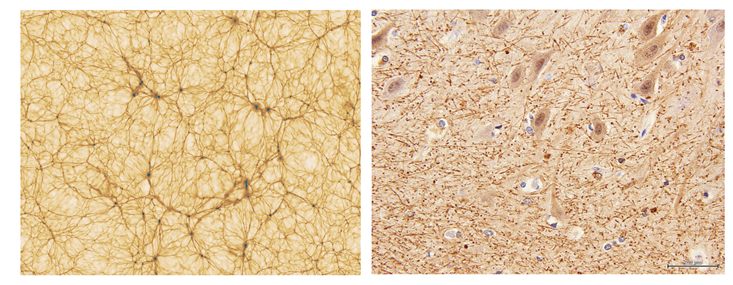
Here it is again : a comparison of the distribution of dark matter in the Universe (from numerical simulations, on the left), to a slice of the human cerebellum (right). Do these look the same to you ? Because they don't to me. Not even close. I mean, good grief. There are whacking great round lumps in the cerebellum image that aren't at all similar to anything in the simulation. The network structure of the dark matter is barely visible in the cerebellum : what paths there are are generally straighter but make sharper twists and turns. The dark matter network structure is visible because of enormous density variations which are not reflected in the brain. So :
The eye immediately grasps some similarity between images of the cosmic web and the brain.
No it fucking doesn't. This is wishful thinking writ large.
A stunning message emerges from the power spectrum graph in Figure 2 (below): The relative distribution of fluctuations in the two networks is remarkably similar, over several orders of magnitude.
A power spectrum doesn't convey the full details of the structure, any more than the standard deviation tells you about coherent formations. And the choice of features they choose to plot is completely arbitrary - it's a garbage comparison that's totally unjustified.
One of us has recently measured how difficult it is to predict how the cosmic network evolves, based on the digital evolution of a simulated universe. This estimate suggests that about 1 to 10 petabytes of data are needed to describe the evolution of the entire observable universe at the scale where its self-organization emerges (or at least of its simulated counterpart).
Whut ? I saw someone running an n-body universe simulation in realtime once. A small one, to be sure, but you don't need enormous amounts of data. It's going to be of the order of megabytes or perhaps kilobytes, not petabytes. The large scale structure emerges very naturally from gravity alone - yeah, you need much more horrendously complex physics for galaxies and stars and stuff, but not for the web. The only thing I can think they're referring to is storing the data "as is" at any step, which could be large, but you definitely don't need anything remotely like a petabyte to store something that's a much, much closer match to the structure of the brain.
It is truly a remarkable fact that the cosmic web is more similar to the human brain than it is to the interior of a galaxy; or that the neuronal network is more similar to the cosmic web than it is to the interior of a neuronal body. Despite extraordinary differences in substrate, physical mechanisms, and size, the human neuronal network and the cosmic web of galaxies, when considered with the tools of information theory, are strikingly similar. 
Does this fact tell us something profound about the physics of emergent phenomena in the two systems? Maybe. But we must take these findings with a grain of salt.
I wouldn't even call these "findings". They are nonsense statements. But suppose for the sake of argument that some similarity were to be objectively and correctly (for these are not at all the same thing) demonstrated. What would it mean ? What do you want us to do with that knowledge ? How does it change anything, knowing that the action of gravity can, under some conditions, produce something that resembles a structure produced by completely different biological processes ? In a word, so what ?

The Strange Similarity of Neuron and Galaxy Networks - Issue 74: Networks - Nautilus

Christof Koch, a leading researcher on consciousness and the human brain, has famously called the brain "the most complex object in the known universe." It's not hard to see why this might be true. With a hundred billion neurons and a hundred trillion connections, the brain is a dizzyingly complex object.

Monday, 1 April 2019

ACRONYM

In this note, we present Acronym CReatiON for You and Me, or ACRONYM, a command-line code that identifies English acronyms from any arbitrary string of text. All "astronomy-valid" acronyms, as well as the appropriate capitalization of the input phrase, are returned to the user, sorted with longest (and therefore best) acronyms first. With widespread use, ACRONYM should revolutionize the field of astronomy by freeing researchers from the burdensome task of brainstorming convoluted acronyms for their projects, adding back countless hours of productive work to the research cycle.

This actually works, and was trivial to install. Some examples :

acronym "Radio astronomy survey of gas in the Virgo cluster" :

  • RADIANCE RADIo astronomy survey of gAs iN the virgo ClustEr
  • RADIATES RADIo astronomy survey of gAs in ThE virgo cluSter
  • RADISHES RADIo astronomy survey of gaS in tHE virgo cluSter
  • RAISINGS RAdIo aStronomy survey of gas IN the virGo cluSter
  • RAVENOUS RAdio astronomy surVEy of gas iN the virgO clUSter
  • REGISTER Radio astronomy survEy of Gas In the virgo cluSTER
  • RESINOUS Radio astronomy survEy of gaS IN the virgO clUSter
  • RESOLUTE Radio astronomy survEy of gaS in the virgO cLUsTEr
  • REVOLTER Radio astronomy survEy of gas in the VirgO cLusTER
  • ROARINGS RadiO AstRonomy survey of gas IN the virGo cluSter
  • ROASTETH RadiO ASTronomy survEy of gas in THe virgo cluster
  • ROMANIST RadiO astronoMy survey of gAs iN the vIrgo cluSTer
  • ROMANTIC RadiO astronoMy survey of gAs iN The vIrgo Cluster

acronym "neutral hydrogen in virgo" :
  • NEARING NEutrAl hydRogen IN virGo
  • NEUTRAL NEUTRAL hydrogen in virgo
  • NUDGING NeUtral hyDroGen IN virGo
  • NEARER NEutrAl hydRogEn in viRgo
  • NEGRO NEutral hydroGen in viRgO
  • NUDGE NeUtral hyDroGEn in virgo
  • NAIN NeutrAl hydrogen IN virgo
  • NEAH NEutrAl Hydrogen in virgo
  • NEAR NEutrAl hydrogen in viRgo
  • NERO NEutral hydrogen in viRgO
  • NING Neutral hydrogen IN virGo
  • NUDE NeUtral hyDrogEn in virgo

 acronym "Inspecting FITS files in three dimensions"
  • INCLINED INspeCting fits fiLes IN threE Dimensions
  • INCLINES INspeCting fits fiLes IN three dimEnsionS
  • INFESTED INspecting Fits filES in ThreE Dimensions
  • INSISTED INSpectIng fits fileS in ThreE Dimensions
  • INSPIRED INSPecting fits files In thReE Dimensions
  • INCEST INspeCting fits filES in Three dimensions
  • INCHES INspeCting fits files in tHree dimEnsionS
  • ISIS InSpecting fits files in three dimensIonS

ACRONYM: Acronym CReatiON for You and Me

Each year, countless hours of productive research time is spent brainstorming creative acronyms for surveys, simulations, codes, and conferences. We present ACRONYM, a command-line program developed specifically to assist astronomers in identifying the best acronyms for ongoing projects.

Tuesday, 19 March 2019

KABOOM !

If there's a 170 kilotonne explosion in the atmosphere and no-one hears it, does it make a sound ?

A huge fireball exploded in the Earth's atmosphere in December, according to NASA. The blast was the second largest of its kind in 30 years, and the biggest since the fireball over Chelyabinsk in Russia six years ago. But it went largely unnoticed until now because it blew up over the Bering Sea, off Russia's Kamchatka Peninsula.

The space rock exploded with 10 times the energy released by the Hiroshima atomic bomb. Lindley Johnson, planetary defence officer at Nasa, told BBC News a fireball this big is only expected about two or three times every 100 years. Measuring several metres in size, the space rock exploded 25.6km above the Earth's surface, with an impact energy of 173 kilotons.

It's reassuring that most of our planet is still empty and that asteroids with such enormous energies don't make it to the ground. Less reassuring is that an explosion many times more powerful than the atomic blast that destroyed Hiroshima can occur without anyone even noticing very much and that it was completely unexpected. Even less reassuring than that is that no-one seems particularly alarmed by this. I mean, it's nice to avoid a panic, but could we maybe just please be a little bit more panicy than we are ?

On the other hand, maybe not. Maybe everyone is already at Peak Panic because of other issues and they don't have any panic left to give. Perhaps the political situation is so dire that people are hoping for another solution entirely. If so, the asteroid can help them with that soon enough.


US detects huge meteor explosion

A huge fireball exploded in the Earth's atmosphere in December, according to Nasa. The blast was the second largest of its kind in 30 years, and the biggest since the fireball over Chelyabinsk in Russia six years ago. But it went largely unnoticed until now because it blew up over the Bering Sea, off Russia's Kamchatka Peninsula.

Thursday, 17 January 2019

The Moon potatoes are all dead

It's a metaphor for Brexit, or something.

The cotton plants that sprouted on the moon's far side aboard China's Chang'e 4 lander are dead, done in by the bitter cold of the lengthy lunar night, GBTimes reported today (Jan. 16).

But the canister apparently does not have a battery-powered heater, so the onset of the lunar night over the weekend spelled doom for the cotton sprouts, GBTimes reported. "Liu Hanlong, head of the experiment at Chongqing University, said at a Chongqing government press conference on Tuesday that the temperature inside the 1-liter-capacity canister had reached minus 52 degrees Celsius [minus 62 degrees Fahrenheit] and the experiment had ended" after 212.75 hours, Andrew Jones wrote in the GBTimes story.
https://www.space.com/43025-china-moon-mission-plants-dead.html

Quantifying the observable effects of Type 3 civilisations

Neat ! Weirdly the link instantly closes for me on Windows, but works under Linux.

With the Sunscreen computer program, we can also figure out what would happen if the aliens are more thrifty when building their megastructures. What would happen if they could cloak stars dimmer than a thousand Suns? Most galaxies roughly fall into two classes: blue galaxies that are still making stars, and red ones where only old stars still survive. In blue galaxies, most of the light comes from blue "dwarf" stars, and the brightest of these are the most blue. So if aliens could cloak all stars fainter than 1,000 Suns, the galaxy would appear bluer than most galaxies. In red galaxies, most of the light comes from red giants, and the brightest of these are also the reddest. Cloaking the fainter red giants makes these galaxies redder, redder than natural galaxies.

http://104.197.48.230/sunscreen/

Tuesday, 15 January 2019

ALMA discovers a star with a polar disc

Binary stars are very common throughout the galaxy, but HD 98000 has a little something extra that made astronomers take special note. As observed by the Atacama Large Millimeter/sub-millimeter Array (ALMA), its protoplanetary disk doesn’t occupy the same plane as the binary orbit; it’s been flipped by 90 degrees over the orbital plane of the binary pair. Although such systems have been long believed to be theoretically possible, this is the first example that has been found.

Should there be a planetary body orbiting the stars on the inner edge of the disk, an observer would be met with a dramatic pillar of gas and dust towering into space with the two stars either side of it in the distance. As they orbit one another, the planetary observer would see them switch positions to either side of the pillar. It goes without saying that any planet orbiting two stars would have very different seasons than Earth. It will even have two different shadows cast across the surface.

http://astroengine.com/2019/01/14/this-weird-star-system-is-flipping-awesome/

Thursday, 3 January 2019

Space 2019

2019 will have all the same race-to-the-bottom politics as the last few years, but at least it's starting with a lot of spacey goodness. That's space spacey. Not Kevin Spacey.

China says it has successfully landed a spacecraft on the far side of the Moon, the first ever such attempt and landing. At 10:26 Beijing time (02:26 GMT), the unmanned Chang'e-4 probe touched down in the South Pole-Aitken Basin, state media said. It is carrying instruments to analyse the unexplored region's geology, as well to conduct biological experiments.

"This huge structure is over 2,500km (1,550 miles) in diameter and 13km deep, one of the largest impact craters in the Solar System and the largest, deepest and oldest basin on the Moon," Andrew Coates, professor of physics at UCL's Mullard Space Science Laboratory in Surrey, told the BBC.

The event responsible for carving out the SPA basin is thought to have been so powerful, it punched through the Moon's crust and down into the zone called the mantle. Researchers will want to train the instruments on any mantle rocks exposed by the calamity.

The lander carries a 3kg (6.6lb) container with potato and arabidopsis plant seeds - as well as silkworm eggs - to perform biological studies. The "lunar mini biosphere" experiment was designed by 28 Chinese universities.

"They're farming on the Moon,
They'll grow potatoes soon,
And there ain't no whales
So they tell tall tales
Of minerals on the Moon."
https://www.bbc.co.uk/news/science-environment-46724727

Wednesday, 2 January 2019

My favourite potato

All snowmen are to be renamed Ultima Thule. Also reminds me of my favourite potato :
https://astrorhysy.blogspot.com/2013/05/why-nasa-are-paying-me-to-photograph.html

The scientists have decided to call the larger lobe "Ultima", and the smaller lobe "Thule". The volume ratio is three to one. Jeff Moore, a New Horizons co-investigator from Nasa's Ames Research Center, said the pair would have come together at very low speed, at maybe 2-3km/h. He joked: "If you had a collision with another car at those speeds you may not even bother to fill out the insurance forms."

"Our current theory as to why Ultima Thule is red is the irradiation of exotic ices." Essentially, its surface has been "burnt" over the eons by the high-energy cosmic rays and X-rays that flood space.

Less than 1% of all the data gathered by New Horizons during the flyby has been downlinked to Earth. The slow data-rates from the Kuiper belt mean it will be fully 20 months before all the information is pulled off the spacecraft.
https://www.bbc.co.uk/news/science-environment-46742298

Wednesday, 5 December 2018

Could dark matter have negative mass ?

I wouldn't get overly-excited; modified gravity theories are ten-a-penny.

However, philosophically this is very appealing. If dark matter is a gravitational superfluid, i.e. deformations in space-time that behave just like a bunch of massive [1] particles, then the hitherto[2] impossible middle ground of both missing mass and modified gravity become possible. It wouldn't be a particle, so direct detection experiments are doomed to failure. But you could absolutely still call it mass. Could you call it matter ? Probably not, it would be completely unlike conventional matter. You could also call it modified gravity. Doesn't mean it would be anything much like MOND - it might, or it could be something different. So both sides get to point and jeer and should "I TOLD YOU SO !" and go home for tea and biscuits. And if it's unified along with the hitherto[3] completely-separate-yet-also-mysterious dark energy, without breaking poor old Einstein, then so much the better.

[1] Meaning, "they've got mass", not that they're especially heavy.
[2] Not meaning to imply that this particular variant is novel in this aspect - it isn't.
[3] I believe this aspect is genuinely novel.

Not that "philosophically appealing" is much of a guide to truth, mind you. It'd be nice though. And I'm not in the least bit qualified to judge this latest theory, before anyone asks. What I don't get - no idea at all if this is a press release issue - is how a negative mass fluid could explain dark matter, which normally behaves very much as though it has positive mass.

EDIT : Thanks Eli Fennell for pointing out that this particular theory isn't about spacetime superfluids, it's just another sort of (presumably more conventional) matter that has negative mass.


https://phys.org/news/2018-12-universe-theory-percent-cosmos.html

Saturday, 1 December 2018

NASA's mission to a metallic asteroid

I wonder if you could get away with wearing magnetic boots here, a la Star Trek VI.

16 Psyche will allow humans their first shot at exploring a world made of iron rather than ice or rock if NASA succeeds. The mission was originally set to begin in 2023, but now the agency is planning on starting in 2022 and making contact in 2026, thanks to a more efficient, lower-cost trajectory discovered by the team.

https://futurism.com/nasa-fast-tracking-plans-explore-metal-asteroid-worth-10000-quadrillion

Tuesday, 27 November 2018

A radar satellite images some choice targets

Sydney Harbour and the Egyptian pyramids feature in the debut images from the first all-UK radar spacecraft. NovaSAR was developed jointly by Surrey Satellite Technology Limited of Guildford and Airbus in Portsmouth, and launched to orbit in September.

Its pictures are now being assessed for use in diverse applications, including crop analysis, flood and forestry mapping, and maritime surveillance. The intention ultimately is to fly a constellation of NovaSAR-like sats. Such a network would enable repeat images of locations to be acquired more quickly - something that is important if changes detected in a scene require a rapid response. Reacting to an oil spill at sea would be a good example.
https://www.bbc.com/news/science-environment-46312874

Tuesday, 20 November 2018

Barnard's Star has planets after all

I remember reading old popular books claiming that Barnard's Star has planets - way back before the modern exoplanet era. Turns out it does, but probably not the ones it was supposed to.

The planet's mass is thought to be 3.2 times that of our own, placing it in a category of world known as a "super-Earth". It orbits Barnard's star, which sits "just" six light-years away. The star is an extremely faint "red dwarf" that's about 3% as bright as the Sun.

Co-author Guillem Anglada Escudé said the newly discovered world was "possibly a mostly rocky planet with a massive atmosphere. It's probably very rich in volatiles like water, hydrogen, carbon dioxide - things like this. Many of them are frozen on the surface".

Dr Anglada Escudé, from Queen Mary University of London, added: "The closest analogue we may have in the Solar System might be the moon of Saturn called Titan, which also has a very thick atmosphere and is made of hydrocarbons. It has rain and lakes made of methane."

The planet, Barnard's Star b, is about as far away from its star as Mercury is from the Sun. On distance alone, it's estimated that temperatures would be about -150C on the planet's surface. However, a massive atmosphere could potentially warm the planet, making conditions more hospitable to life.

When the next generation of telescopes come online, scientists will be able to characterise the planet's properties. This will likely include a search for gases like oxygen and methane in the planet's atmosphere, which might be markers for biology. "The James Webb Space Telescope might not help in this case, because it was not designed for what's called high contrast imaging. But in the US, they are also developing WFirst - a small telescope that's also used for cosmology," said Dr Anglada Escudé.

WFIRST will have a mirror the same size as Hubble's (2.4 m diameter), designed for big cosmological projects, with a budget of $3.2 billion. Calling it a "small telescope that's also used for cosmology" is a bit like saying that coffee is a minor drink popular in some parts of the world and also used to keep people awake.

"If you take the specs of how it should perform, it should easily image this planet. When we have the image we can then start to do spectroscopy - looking at different wavelengths, in the optical, in the infrared, looking at whether light is absorbed at different colours, meaning there are different things in the atmosphere."

https://www.bbc.com/news/science-environment-46196279

Hitting an asteroid with a katana

In a paper detailing early experiments, the team – including Genrokuro Matsunaga, a 70-year-old swordsmith and Takeo Watanabe at Kanagawa Institute of Technology – explain how they have made several rock corers with various metallic compositions. Four contain tamahagane, the traditional metal made from iron sand and charcoal that is used in Japanese swords. “To achieve the sharpness and plasticity demand of the corer tip, we borrowed the techniques of traditional Japanese sword-smithing in fabricating the corer samples,” the authors write.

The resulting corers are small, cylindrical devices with a bladed edge angled inwards. Instead of swiping a katana sword at the asteroid – which would be cool but impractical – the idea is to launch the tamahagane-tipped corer at the space rock at great speed. In theory, it will dig into the asteroid and allow for a sample to be scooped up. A tether back to the mothership spacecraft could then reel the device and asteroid fragments in.

Yeah, you lost me at "swiping at a katana sword at the asteroid". Everything from this point on is redundant and only for interest's sake.

But even getting surface or near-surface samples is difficult because of a basic property of asteroids: they’re small and don’t have much of a gravitational pull. Every time a rover or collecting device connects with or pushes down against an asteroid, it can easily bounce back off it again. “Anything that allows you to use less force to cut into the asteroid surface – like this tamahagane steel – has to help,” says Elvis.

So far, the Japanese team have tested some of their corers by dropping them down a long pipe towards a concrete slab at the bottom of a tall stairwell. The samplers successfully extracted some concrete, but occasionally dropped it when being retrieved. “A mechanism to prevent samples from falling off during the extraction and recovery phase needs to be devised,” the authors note.

Plus, the tamahagane corers themselves were not tested – because they were so expensive. Still, these are the first steps towards blasting a sword-inspired sampling technology into space.
http://www.bbc.com/future/story/20181113-a-samurai-swordsmith-is-designing-a-space-probe

Saturday, 17 November 2018

Just watch the damn video

Epic. Watch it on the biggest screen you can find at a volume level liable to induce involuntary bowel movements. Don't watch it on your mobile phone or I shall personally come and spit in your eye. A strong contender for the title of "best thing I've seen all year". It might not be to everyone's taste, but those people are objectively wrong and I don't like them.

Originally shared by Frank Summers

For the past 18 months, we have been working with composer / conductor Eric Whitacre on astronomy visuals to accompany his Hubble-inspired symphony “Deep Field”. The film was just released on YouTube today, and we are traveling to Kennedy Space Center for the VIP premiere tonight.

We hope you enjoy this artistic combination of evocative music and celestial wonders. More info at deepfieldfilm.com

https://www.youtube.com/playlist?list=PL3r-Yu9CBDbxPnzCLdXqkPkr4QJwV_FDk

http://deepfieldfilm.com

Friday, 16 November 2018

Artificial gravity in space may not make us dizzy after all

Very cool. Via Troy, who comments :

So the pop-science articles on the internet often make a big noise about spinning ships for artificial gravity, and that only 2 revolutions per minute is acceptable otherwise you get motion sickness: that famous centrifuge inside Discovery from 2001: A Space Odyssey would have to spin too slow to generate decent gravity.

But in space, the human body adapts by basically turning off the inner ear. Here's Tim Peake being by spun around by another astronaut at a rather insane speed - looks like 60 RPM, and he is in perfect control of his stomach contents. So, the Discovery centrifuge with its seemingly high rotation rate of 6RPM would be perfectly feasible for astronauts to adapt to.

In fact, astronauts aboard Skylab made their own gravity by running around the circular storage locker "track" at greater than 10RPM with no mentions of dizzyness or sickness.

I confirm he's spinning at about 1 revolution per second. So how many g's is that ? If his head is about 0.5 m away from the axis of rotation, that's a distance of 3.14 m per spin, so a linear velocity of 3.14 m/s. Which gives an acceleration of about 2 gs, which seems crazy.
https://www.youtube.com/watch?time_continue=6&v=GPnLShiJ-t4

Review : Epic Slavic Myths

Following a now well-established procedure, after that delightful but short offering from Thames & Hudson , I turn to a longer collecti...