Sister blog of Physicists of the Caribbean in which I babble about non-astronomy stuff, because everyone needs a hobby
Showing posts with label Statistics. Show all posts

Thursday, 10 August 2023

Calling Lizardshit

A short post to summarise two pieces I found, which I think quite nicely help explain why opinion polls sometimes come up with apparently large numbers of people believing batshit crazy ideas.

Incidentally... "bullshit" is well-recognised as meaning not caring about the truth, "batshit" seems already a standard way of emphasising the absurdly stupid, "horseshit" appears to to generally used as a synonym of "outright lie", and "chickenshit" appears to mean too cowardly to admit the truth. Do we need to add "lizardshit" as a term for "stupid poll making dumb statistical mistakes" ? Maybe.

But first, why lizards ? 

The lizardman constant, says the first piece, is the observation that a small fraction of survey responses are literally bullshit. That is, they are totally wrong for a wide variety of reasons : jokes, boredom, ignorance, insanity, mistakes, lazy, malice, innocent misunderstandings, idiocy. It gives numerous examples of which I will quote only a few here :

  • 2% of Americans have “never heard of” institutions such as “the police” or the “U.S. Supreme Court”
  • 7% say chocolate milk comes from brown cows and 19% that hamburgers come from pigs
  • 6–8% of Americans think they could kill a grizzly bear, lion, elephant, or gorilla with their bare hands
  • 5% of atheists are “absolutely” or “fairly certain” that they believe in God
  • 14% of undecided voters said Hillary Clinton might be a demon, but they might vote for her; 2% of Clinton supporters said she was and they would
  • 1% of Brits who believe you should be imprisoned for 15 years (or more) if you ever fail to wear a seatbelt in your car
Needless to say, the actual fractions of the populace at large that believe in total hogwash like the above is likely orders of magnitude lower than the surveys suggest. That's the point, not that 5% – which appears to be a reasonable value for the Lizardman Constant – really do believe in lizard people.

Below a certain percentage of responses, for sufficiently rare responses, much or all of responding humans may be lying, lazy, crazy, or maliciously responding and the responses are false. This systematic error seriously undermines attempts to study rare beliefs such as conspiracy theories, and puts bounds on how accurate any single survey can hope to be... The reality is that humans don’t answer questions reliably, accurately, or honestly even close to 100% of the time, and shamelessly fail ‘common sense’ or ‘logic’ or ‘arithmetic’ questions all the time, requiring extensive precautions, careful survey design, and just throwing out a lot of data as garbage.

4-5% isn't so small. So when you get down to even, say, 20% or so, a significant fraction of those responses will be pure bullshit. This does not mean that surveys in general are full of crap, but more that any one survey might well be. If you want a more accurate result you need meta-surveys, asking different people in different places the same thing in different ways, etc.

Note also that "any one survey" is distinct from "every individual survey". They're not the same thing at all. Some individual surveys do get the right answers, and by way of example, I'll point back to that survey of Tory party members, a majority of whom would be willing to sacrifice their own party for the sake of Brexit. Lizardshit ? Methinks not, given that these were the same people who, subsequently, looked at the various leadership candidates squarely in the eye, and decided that the one with less staying power than a lettuce would be the one most suitable to lead the country.

On to the second piece*, which is a case study of a poll claiming that a quarter of Brits believe the coronavirus was a hoax. This is quite obviously nonsense, but the piece does a nice dissection of how to consider this finding critically. After mentioning Lizardman (only 9% said "definitely", which is not far off the constant), it takes a look at what "hoax" could mean to people :

* I already mentioned this before elsewhere, but felt I needed a more permanent record of it.

There’s a whole spectrum of heterodox views on Covid: those who question lockdowns, those who argue the virus was much less deadly than the medical establishment told us, those who believe governments used Covid as an excuse to enact authoritarian policies, all the way to the far more extreme groups of antivaxxers and those who believe the virus never existed in the first place... I bet a huge number of people answering the very vague question in the poll had other – perhaps still technically untrue, but far less outrageous – things in mind. 

And then it reports that a YouGov poll where the question was worded unambiguously gave numbers deep into Lizardman : 3%. But it goes further, asking to consider the implications of other numbers from the same poll :

7 per cent of people said they had already taken part in such a rally. If that were true and representative of the UK adult population (which is about 53 million: the 67 million total population less the 14 million under-18s), it would mean that something like 3.7 million people had already taken direct action and joined a protest against these supposed conspiracies.

What this is telling us is that this poll is seriously flawed in some way. It doesn't tell us exactly what the issue is, but clearly something is wrong.

The pollsters also asked the public whether they’d heard of the conspiracy newspaper the Light – the subject of a BBC article and podcast released this week. A surprising 14 per cent of respondents (7.4 million people, if that’s representative of the UK adult population) said they’d heard of the newspaper... of those who’d heard of it, 40 per cent said they were subscribers – if this was representative, it would mean that more than 2.9 million people in the UK subscribe to the Light – five times as many as subscribe to the Times. 

But of course, it’s not true. By the time you take 40 per cent of 14 per cent of the sample in the poll, you’re down to just 314 people, and all representativeness is out of the window.

Which is a simple, effective tip for considering if a poll is telling you something is meaningful or not. A poll of a thousand people might give you something truly representative on a clear-cut issue, but once it starts to get so some complex that it all fragments, numbers become unrepresentatively small very quickly. And that's without considering how the question was worded, how the sample was collected, etc.

I don't know if we really need "lizardshit" as a broader term for the problems specific to opinion polls, or if we can just get away with calling it a variety of bullshit. On the other hand, polls are so common, perhaps it would serve as a reminder not to take them on face value. Lots of people are undeniably very, very stupid... but generally nowhere near as much as most polls seem to suggest. And that's probably worth remembering.

Wednesday, 4 November 2020

These statisticians will shock you !

My university education included very little about the people behind the science. Besides a few obligatory anecdotes about Fritz Zwicky, and a picture of Thompson looking incredibly smug at having just discovered the electron, there wasn't much at all even about the history of science - let alone any biographical information. In some ways this is a good thing. Science strives for objectivity : the original purpose of a parameter should not matter, only understanding how to use it. What matters most is the collective, accumulated scientific knowledge, not a detailed understanding of long-debunked notions of yesteryear.

"I discovered the electron. Now it's time for coffee."

Of course this has a weakness. With such a narrow focus on current understanding, we miss out on a philosophical exploration of what happened : sure, we can learn about the current best practises, but at the expense of understanding how we got to where we are now. Sociologically, it's not a good idea to be totally ignorant of how discoveries happened - it brushes aside both ugly facts and beautiful truths (the story of Ruby Payne Scott alone encapsulates both). This is not healthy. We should have some inkling of whether a discovery was made by a racist maniac or a disabled lesbian war veteran. It's inherently a good thing to know. And while our investigations into galaxies and hydrodynamics probably benefit from a coolly analytic approach, and couldn't be much influenced by racist ideologies even if we wanted them to, the same cannot be said for sociological statistics. Keeping things "objective" in this case is arguably dehumanising. 

My suggestion is that each lecture course in the sciences should dedicate one, or at most two, additional lectures to the history of its subject. It wouldn't have to form part of the assessment. It would add a lot of interest in what are otherwise some very dry areas, and well as providing information which is all too easily forgotten. A couple of quotes on the monsters in the field will suffice.

Fisher continued to have disturbingly close ties to Nazi scientists even after the war. He issued public statements to help rehabilitate the image of Otmar Freiherr von Verschuer, a Nazi geneticist and advocate of racial hygiene ideas who had been a mentor to Josef Mengele, who conducted barbaric experiments on prisoners in Nazi camps. In von Verschuer’s defense, Fisher wrote, “I have no doubt also that the [Nazi] Party sincerely wished to benefit the German racial stock, especially by the elimination of manifest defectives, such as those deficient mentally, and I do not doubt that von Verschuer gave, as I should have done, his support to such a movement.”

According to Pearson, conflict between races was inevitable and desirable because it helped weed out the bad stock. As he put it, “History shows me one way, and one way only, in which a high state of civilization has been produced, namely the struggle of race with race, and the survival of the physically and mentally fitter race.”... Pearson considered the colonial genocide in America to be a great triumph because “in place of the red man, contributing practically nothing to the work and thought of the world, we have a great nation, mistress of many arts, and able ... to contribute much to the common stock of civilized man.”

Which would probably be a "holy shit !" moment from John Oliver. The average man in the street probably hasn't heard of Fisher or Pearson, but the average scientist probably has. I've used their findings - their impact was far-reaching indeed.

As a statistician, Fisher is personally responsible for many of the basic terms that now make up the standard lexicon, such as “parameter estimation,” “maximum likelihood,” and “sufficient statistic.” But the backbone of his contributions was significance testing. Fisher’s 1925 textbook Statistical Methods for Research Workers, containing statistical recipes for different problems, introduced significance testing to the world of science and became such the industry standard that anyone not following one of his recipes would have difficulty getting published... In the process, his methods made possible whole new research hypotheses: questions like whether two variables were correlated, or whether multiple populations all had the same mean.

Which doesn't sound like a fundamentally racist ideology, and it isn't. What Fisher got wrong was his interpretation of what this all meant. He seems to have had an innately binary, absolutist viewpoint : this is right or wrong, the data either supports a conclusion or it doesn't, with those conclusions being inescapable from the data alone. Again, to re-use a useful quote, "it's the difference between thinking that all the facts you have are all the facts there are".

Like Pearson, Fisher maintained that he was only ever following the numbers where they took him. Significance testing, for Fisher, was a way of communicating statistical findings that was as unassailable as a logical proof. As he wrote in 1932, “Conclusions can be drawn from data alone ... if the questions we ask seem to require knowledge prior to these, it is because ... we have been asking somewhat the wrong questions.”

Last year, a letter signed by over 800 scientists called for an end to the concept of statistical significance, and the leadership of the American Statistical Association issued a blunt decree: “Don’t say ‘statistically significant.’ ” The heart of the problem with significance testing is that making binary decisions about homogeneity was never a meaningful statistical task. With enough data, looked at closely enough, some inhomogeneities and statistically significant differences will always emerge. In the real world, data are always signaling something. It just may not be clear what.

As first argued by psychologist Edwin Boring in 1919, a scientific hypothesis is never just a statistical hypothesis—that two means in the population are different, that two variables are correlated, that a treatment has some nonzero effect—but an attempt at explaining why, by how much, and why it matters. The fact that significance testing ignores this is what economists Deirdre McCloskey and Stephen Ziliak in their 2008 book The Cult of Statistical Significance called the “sizeless stare of statistical significance.” As they put it, “Statistical significance is not a scientific test. It is a philosophical, qualitative test. It does not ask how much. It asks ‘whether,’ ”—as in, whether an effect or association simply exists. “Existence, the question of whether, is interesting,” they said, “but it is not scientific.”

But it may not be obvious as to how this kind of thinking - flawed though it is - translates into racism. I would hope that in the modern world it's inherently obvious that you can't simply say that something is either significant or it isn't; the very fact that p can take any value ought to indicate that (dare I say it !) all by itself. Pretty much everyone uses different sorts of significance measures but hardly anyone in the sciences, in my experience, is driven to become a proponent of Eugenics Wars as some of the early statisticians were. Indeed, this binary-absolutist style of thought seems incredibly ironic : statistics, to me, inherently relies on understanding various biases. To do statistics properly inherently relies on considering alternative interpretations and trying to avoid fooling oneself. How, then, did the attempt at objectivity lead to such vile conclusions ? The answer, I think, is that it didn't.

For the purposes of eugenic discrimination, it was enough to state that distinct racial subgroups existed or there was a “significant” correlation between intelligence and cleanliness or a “significant” difference in criminality, fertility, or disease incidence between people of different socioeconomic classes. The first hypotheses were taxonomic: whether individuals could be considered to be of the same species, or whether people were of the same race. 
The separation was everything—not how much, what else might explain it, or why it mattered, just that it was there. Significance testing did not spring fully formed from the heads of these men. It was crafted and refined over the years specifically to articulate evolutionary and eugenicist arguments. Galton, Pearson, and Fisher the eugenicists needed a quantitative way to argue for the existence of such differences, and Galton, Pearson, and Fisher the statisticians answered the call with significance testing.

I would suggest that binary thinking can drive racism, but racism doesn't necessarily follow directly from it. Despite the protestations of the early statisticians, you have to have some underlying preference for it in the first place, which you can use data to incorrectly support. A career in statistics isn't going to lead to joining the KKK unless you already have a perverse and warped mindset. These early villains were expressing their existing beliefs through their undoubted analytic prowess, not having their opinions shaped by the data. They would fall firmly in the top-left of the supervillain chart. In short, crude and racist ideas drove statistical methodologies, not the other way around.

Most scientists now understand that the data do not speak for themselves and never have. Observations are always possible to interpret in multiple ways, and it’s up to the scientist and the larger community to decide which interpretation best fits the facts  What we should be asking is what causal mechanism explains the difference, whether it can be applied elsewhere, and how much benefit could be obtained from doing so.

I'm pleased to report that I made that exact same first statement, almost word for word, in my lectures on galaxy evolution :

The most obvious (and tempting) conclusion from this graph, if we take it at face value, is that chocolate makes you more intelligent. But again, we don't really know what the independent variable is here. It would be equally valid to suggest that maybe it's the other way around. Maybe when someone in a country wins a Nobel prize, the rest of the populace eat chocolate in celebration ! My point is that the data doesn't interpret itself. Interpretation is something that happens in your head - there and nowhere else - and not by the data itself.

Returning to the Nautil.us article :

 “What the future of science needs is a democratization of the analysis process and generation of analysis,” and that what scientists need to do most is “hear what people that know about this stuff have been saying for a long time. Just because you haven’t measured something doesn’t mean that it’s not there. Often, you can see it with your eyes, and that’s good enough.”

Exactly ! With the proviso that of course this doesn't mean chucking statistics out completely - that's the attitude of a racist idiot - only that they don't tell the whole story by themselves. They inform the story but never dictate it. If you can see a trend by eye, you can quantify it statistically, but if you can't, then you have to be much more careful about what the statistics are saying. Your eyes can certainly fool you, but so can numbers. There is no philosophically iron-clad method for establishing truth.

In the 1972 book Social Sciences as Sorcery, Stanislav Andreski argued that, in their search for objectivity, researchers had settled for a cheap version of it, hiding behind statistical methods as “quantitative camouflage.” Instead, we should strive for the moral objectivity we need to simultaneously live in the world and study it. “The ideal of objectivity,” Andreski wrote, “requires much more than an adherence to the technical rules of verification, or recourse to recondite unemotive terminology: namely, a moral commitment to justice—the will to be fair to people and institutions, to avoid the temptations of wishful and venomous thinking, and the courage to resist threats and enticements.”

How Eugenics Shaped Statistics - Issue 92: Frontiers - Nautilus

In early 2018, officials at University College London were shocked to learn that meetings organized by "race scientists" and neo-Nazis, called the London Conference on Intelligence, had been held at the college the previous four years. The existence of the conference was surprising, but the choice of location was not.

Thursday, 8 October 2020

Super Spreaders Are Super Statistical

The usefulness of statistical parameters is hugely context-dependent. Even very simple quantities like the mean and standard deviation don't always give meaningful information. The latter is particularly vulnerable : if the distribution is indeed close to Gaussian then it's invaluable, but if it isn't, then it can be woefully misleading. But even the simple mean or median isn't immune - you can have data sets which simply don't have "typical" values that could be described by a single, simple parameter. Of course, this doesn't mean statistics is useless (far from it !), only that actually understanding what you're measuring is not so straightforward.

In the context of the pandemic, this article from The Atlantic does the best job I've yet seen of explaining why the R number is misleading. I've seen references to the "k" value before but they weren't so well-explained and I didn't really get it until now. That said, without any fear of hypocrisy I have to say that this article is far, far too long. The important bits can be reduced to a few paragraphs.

The definition of k is a mouthful, but it’s simply a way of asking whether a virus spreads in a steady manner or in big bursts, whereby one person infects many, all at once. After nine months of collecting epidemiological data, we know that this is an overdispersed pathogen, meaning that it tends to spread in clusters, but this knowledge has not yet fully entered our way of thinking about the pandemic — or our preventive practices.

A recent paper found that in Hong Kong, which had extensive testing and contact tracing, about 19 percent of cases were responsible for 80 percent of transmission, while 69 percent of cases did not infect another person. This finding is not rare: Multiple studies from the beginning have suggested that as few as 10 to 20 percent of infected people may be responsible for as much as 80 to 90 percent of transmission, and that many people barely transmit it. This highly skewed, imbalanced distribution means that an early run of bad luck with a few super-spreading events, or clusters, can produce dramatically different outcomes even for otherwise similar countries. 

It makes some degree of intuitive sense that if the spread is dominated by the super spreaders, then it will be unpredictable and chaotic and not follow any neat expectations. But who are these super spreaders ? Are they a particular demographic, some group who are naturally more infectious, or is it more a function of behaviour and/or environment ? According to this it seems to be mainly environmental, but not all factors are yet accounted for.

In study after study, we see that super-spreading clusters of COVID-19 almost overwhelmingly occur in poorly ventilated, indoor environments where many people congregate over time—weddings, churches, choirs, gyms, funerals, restaurants, and such—especially when there is loud talking or singing without masks... Cevik identifies “prolonged contact, poor ventilation, [a] highly infectious person, [and] crowding” as the key elements for a super-spreader event. Super-spreading can also occur indoors beyond the six-feet guideline, because SARS-CoV-2, the pathogen causing COVID-19, can travel through the air and accumulate, especially if ventilation is poor. 

So does the R number even really mean anything, or is it so strongly dependent on environment and other factors that we can't actually say if someone typically spreads it to N other people ? From the above it sounds like the latter is closer to reality. While this largely invalidates all those nice graphical explanations about exponential growth, it clearly doesn't mean the virus is less dangerous than thought - the figures speak for themselves on that front. What it might mean is that it's potentially more controllable. And it has interesting consequences for contact tracing : we should concentrate on going backwards, finding the source of the infections rather than who might become infected next.

The reason for backward tracing’s importance is similar to the friendship paradox: your friends are, on average, going to have more friends than you. Friendships are not distributed equally; some people have a lot of friends, and your friend circle is more likely to include those social butterflies, because how could it not? They friended you and others. And those social butterflies will drive up the average number of friends that your friends have compared with you, a regular person. (Of course, this will not hold for the social butterflies themselves, but overdispersion means that there are much fewer of them.)

Or in short you're more likely to know someone popular than be popular yourself. This is important :

...if we can use retrospective contact tracing to find the person who infected our patient, and then trace the forward contacts of the infecting person, we are generally going to find a lot more cases compared with forward-tracing contacts of the infected patient, which will merely identify potential exposures, many of which will not happen anyway, because most transmission chains die out on their own... “backward tracing increases this maximum number of traceable individuals by a factor of 2-3, as index cases are more likely to come from clusters than a case is to generate a cluster.”

Presumably this would also help identify if super spreaders are some particular demographic, people with naturally high infectivity, or driven by environment. If we knew that, we could pre-emptively tackle the worst spreading areas before they even begin.

This Overlooked Variable Is the Key to the Pandemic

Updated at 1:17 p.m. ET on October 1, 2020 There's something strange about this coronavirus pandemic. Even after months of extensive research by the global scientific community, many questions remain open. Why, for instance, was there such an enormous death toll in northern Italy, but not the rest of the country?

Wednesday, 17 June 2020

Apparently, some people don't believe bias affects behaviour

Two very different takes on the nature of bias and how to overcome it - in particular, implicit racial bias. Trying to raise issues to consciousness is important and worthwhile, but how much influence this really has is subject to a host of caveats. My feeling is that it does help, but it awareness alone rarely bestows instantaneous control. Being aware that you should or shouldn't do something isn't enough by itself to stop you from wanting to do it (or not do it).


This first article is - spoiler alert - shite. Absolutely shite. It's self-inconsistent to a degree seldom found outside of presidential tweets, and I'm more than a little skeptical of some of its claims. I'm pretty confident I did a lot more background reading to write this post than the authors did, because I actually read the links they cite in support of their claims and I don't believe they did even this.

What's the big problem ? Well, the article says not merely that implicit bias is not much of a thing, a notion I'd be prepared to at least entertain, but even that our explicit biases don't matter very much. And that's just... odd. First, the idea that implicit bias isn't much of a thing :
Contrary to what unconscious bias training programs would suggest, people are largely aware of their biases, attitudes, and beliefs, particularly when they concern stereotypes and prejudices. Such biases are an integral part of their self and social identity... Generally speaking, people are not just conscious of their biases, but also quite proud of them. They have nurtured these beliefs through many years, often starting in childhood, when their parents, family, friends, and other well-meaning adults socialized the dominant cultural stereotypes into them. We are what we believe, and our identity and self-concept are ingrained in our deepest personal biases. (The euphemism for these is core values.)
Well, surely everyone is aware of their explicit bias by definition. But the whole point of implicit bias is that it's unconscious. It doesn't arise out of choice, or an active desire to discriminate. This is why people can have implicit biases even against their own social groups. So I don't think the first sentence makes much sense : nothing is "contrary", the two biases are wholly different. And the article has a subheading that "most biases are conscious rather than unconscious", but nothing is offered to support this claim (how would you even measure how many unconscious biases someone has anyway ?). Not a great start.
Contrary to popular belief, our beliefs and attitudes are not strongly related to our behaviours. Psychologists have known this for over a century, but businesses seem largely unaware of it. Organizations care a great deal about employee attitudes both good and bad. That’s only because they assume attitudes are strong predictors of actual behaviors, notably job performance. 
However, there is rarely more than 16% overlap (correlation of r = 0.4) between attitudes and behavior, and even lower for engagement and performance, or prejudice and discrimination. This means that the majority of racist or sexist behaviors that take place at work would not have been predicted from a person’s attitudes or beliefs. The majority of employees and managers who hold prejudiced beliefs, including racist and sexist views, will never engage in discriminatory behaviors at work. In fact, the overlap between unconscious attitudes and behavior is even smaller (merely 4%). Accordingly, even if we succeeded in changing people’s views—conscious or not—there is no reason to expect that to change their behavior.
Wait... what ? Doesn't this flatly contradict the first passage that "we are what we believe" ? This all feels highly suspicious. In fact, on reflection I think it's a deliberate attempt to sow confusion.

Intuitively, the stronger a belief someone holds, the more likely they are to engage in the corresponding behaviour. But that doesn't mean we therefore expect the correlation to be extremely strong, because lord knows there are a bunch of things I'd like to do but physically can't*. I firmly believe that flying like Superman would be a jolly good thing, but I don't even enjoy air travel. Hell, I find driving a terrifying experience and would go to extreme lengths to avoid ever having to do it again. Does that stop me wanting a jetpack ? No. And I'd quite like to be an astronaut, but my belief that it would be worthwhile isn't enough to motivate to drop everything and switch career. That'd be silly.

* Also on statistical grounds, causation doesn't necessarily equal correlation.

Some beliefs are pure fantasy : there's a genuine difference between belief, desire, and behaviour. Sometimes we just can't act on our beliefs, either because they're physically impossible or because we're subject to other forces like social pressure. We might not want to smoke but give in to peer pressure*, or vice-versa. We use metadata of who believes what just as much as we do raw evidence, and such is the power of this metadata-based reasoning** that people even insert their genitals into people with whom their own sexual orientation is in direct disagreement. The blunt-force manifestation of this is the law, preventing us from doing (or wanting to do) things we might be otherwise inclined to attempt. Law both constrains our actions directly but also maintains us culturally from even having certain desires*** in the first place.

* I'm hoping this example is hugely dated and no longer much of a thing.
** Not sure what else to call it. "Groupthink" has a more specific reasoning of a false consensus, "peer pressure" is too direct, and "thinking in groups" just doesn't cut it. See these posts for an overview.
*** Hugely simplifying. I'm not saying we'd all become murderers without laws, but these footnotes are already excessive.

Then there are conflicting beliefs. People may believe, say, that all ginger people are evil, but also that it's important to be respectful, in which case it should be no surprise that their behaviour doesn't always reflect one of those beliefs. If, on the other hand, they believe ginger people are evil and that they should always express themselves honestly, then it should come as no surprise to find them saying nasty things about redheads. Personality plays a huge role.

All this undermines the direct implication of the above quote that we should expect a very strong correlation between beliefs and behaviours. Even if beliefs do drive behaviours, other constraints are also at work. Conversely, this also lends some support to the idea that those who do engage in discriminatory behaviours do not necessarily hold prejudiced views : "I was only following orders" and all that. You don't even necessarily need to dislike them to be convinced you need to murder them.

But I think it's a complete nonsense (literally, it does not make sense) to go that extra step and suggest that changing beliefs won't change behaviour. As the old saying goes, "not everyone who voted for Brexit was a racist, but everyone who was a racist voted for Brexit" : things aren't always neatly reversible (granted it's more subtle than that). Changing beliefs can change behaviour either directly or by changing the pervading culture of laws, rules, and social norms.

So that there's only a modest correlation between belief and behaviour, in my view, in no way whatsoever implies that changing beliefs won't change behaviour. Just because belief isn't the dominant driver of belief doesn't imply that it isn't a driver at all. Indeed, it could well be the single biggest individual contributing factor, just smaller than the sum of all the rest. As we'll see, there's some evidence for that.

I'm also not at all convinced by the claim that most racist behaviour couldn't have been predicted from their attitudes - the weak correlation alone doesn't feel like good evidence for this. Yes, this could happen to a degree, due to social forces etc. But at some level, someone consciously engaging in discriminatory practises (unlike implicit bias) must by definition hold discriminatory beliefs. And how are they defining "racist or sexist" behaviour here anyway ? This matters. I'll quote myself here because I think the concept is useful :
The "angry people in pubs", on on the internet, are often what we might call armchair bigots. They won't, unless strongly pressured, ever take physical action against people they dislike. But they are all too willing to vote on policies which harm other people. They care just enough about the truth to have the decency to be embarrassed (even if only unconsciously) by their opinions, but they're all too happy to absolve themselves of responsibility and let other people do their dirty work. This is a very dangerous aspect of democracy, in that it makes villainy much easier by making it far less personal.
So this claim about how attitudes and behaviour correlate in a strange way is just too weird to reduce it to a few casual sentences. More explanation is required.

The article links three papers in this passage. The first, which they cite in support of the "weak" correlation, says in the first sentence of its abstract that it's social pressures which weaken or moderate the belief/behaviour trend, as already discussed. It also notes that the correlation value of 0.4 is pretty strong by other psychological standards. It's a meta study of almost 800 investigations, and doesn't mention racism or sexism (which is what the Fast Company article is concerned with). It explicitly says that beliefs predict some behaviours better than others, which is hardly unexpected.

So I call foul on the Fast Company article, which is using a general study to support specific claims not backed up by the original research, which does not say that the trend is weak in all cases. Sure, social pressure is important, but it's completely wrong to say this means beliefs don't matter.

The second paper is also concerned with measuring the correlation but has nothing to do with prejudice. It's a bit odd to even mention it. The third paper, from 1996, is concerned with prejudice and discrimination and does indeed find a weaker correlation than the general case (r=0.3) - provisionally.

It's a good read. It's another meta study and describes the limitations and inhomogeneities of the various samples, but straightaway even the Fast Company claim for a weaker correlation looks to be on shaky ground. Correcting for the different sample sizes, the paper shows the correlation rises from 0.286 to 0.364, barely lower than the average. And exactly which parameters are used affects this further, with the highest average (sample-size corrected) correlation being 0.416 when examining support for racial segregation. Some individual studies reported even higher correlations, in excess of 0.5 or even 0.6. Overall, correlations were stronger when looking at survey data than experimental data, perhaps because - they suggest - people don't want to openly appear to be prejudiced.

(What I'm not clear about is what the authors mean by "discriminatory intention". They define prejudice as merely holding views, whereas discrimination is putting those views into practice. Discriminatory intention, as far as I can tell, is another type of prejudice.)

Two of their concluding points deserve to be quoted :
Though the prejudice-discrimination relationship is not very strong in general, it varies, to a considerable degree, across specific behavioral categories, and it seems that the relationship is stronger in those cases where the behavior is under volitional control of the subjects. 
In sum, we conclude: only rarely is prejudice a valid predictor for social discrimination, but there are only very few other candidates, and all of these are less useful than prejudice.
I call bollocks on the Fast Company article. They twist the conclusions to mean something very different from what the original authors said.

What of their claim that there's only a "4% overlap" between unconscious attitudes and behaviour ? For this they cite a Guardian article. But this is cherry picking in extremis - the article doesn't say implicit bias is weak (far from it, quoting a number of other studies showing it's a strong effect), it only notes the flaws in certain testing. Fast Company continue with their willful stupidity :
Furthermore, if the test tells you what you already knew, then what is the point of measuring your implicit or unconscious biases? And if it tells you something you didn’t know, and do not agree with, what next? Suppose you see yourself as open-minded (non-racist and nonsexist), but the test determines that you are prejudiced. What should you do? For instance, estimates for the race IAT suggest that 50% of black respondents come up as racially biased against blacks.
That's the whole frickin' point of implicit bias : it's different from explicit bias. Why is this complicated ?

While their conclusion that "bias doesn't matter" is clearly rubbish, they are right to point out, though, that overcoming this bias is difficult. What they don't offer, despite their clickbaity headline, is any hint at at all on what better method is available to overcome it. Although they do conclude that bias is a problem and we should do more (or something differently) to improve how we deal with it, this frankly feels schizophrenic after they just spent the whole article veering wildly back and forth between "bias being how we identify ourselves" and "bias being totally unimportant".

This is a daft article. It doesn't make any sense. It mangles the conclusions of academic papers in order to support a conclusion it doesn't believe in. Aaargh.

Take-home message : bias does matter. That's what the evidence says, very clearly, despite numerous and interesting complications.


Time for the second article. Don't worry, this one can be much shorter, because it's self-consistent and sensible. It fully accepts that implicit bias is important and doesn't say anything stupid about explicit bias being something we can ignore.
That particular implicit bias, the one involving black-white race, shows up in about 70 percent to 75 percent of all Americans who try the test. It shows up more strongly in white Americans and Asian Americans than in mixed-race or African Americans. African Americans, you’d think, might show just the reverse effect — that it would be easy for them to put African American together with pleasant and white American together with unpleasant. But no, African Americans show, on average, neither direction of bias on that task. Most people have multiple implicit biases they aren’t aware of. It is much more widespread than is generally assumed.
However, the author of this piece is also skeptical as to whether implicit bias training is actually improving things or not.
I’m at the moment very skeptical about most of what’s offered under the label of implicit bias training, because the methods being used have not been tested scientifically to indicate that they are effective. And they’re using it without trying to assess whether the training they do is achieving the desired results. 
I see most implicit bias training as window dressing that looks good both internally to an organization and externally, as if you’re concerned and trying to do something. But it can be deployed without actually achieving anything, which makes it in fact counterproductive. After 10 years of doing this stuff and nobody reporting data, I think the logical conclusion is that if it was working, we would have heard about it.
Training methods apparently either don't work or their effects are extremely short-lived :
One is exposure to counter-stereotypic examples, like seeing examples of admirable scientists or entertainers or others who are African American alongside examples of whites who are mass murderers. And that produces an immediate effect. You can show that it will actually affect a test result if you measure it within about a half-hour. But it was recently found that when people started to do these tests with longer delays, a day or more, any beneficial effect appears to be gone... It’s surprising to me that making people aware of their bias doesn’t do anything to mitigate it.
I'm not surprised at all. Dedicated training sessions take people out of their usual information network and temporarily embed them in a new one. Once you take them out, they're assaulted once again by their old sources of bias. Maintaining awareness from one particular session, especially if its conclusions run counter to everyday sources, is not at all easy. Raising issues to awareness does help you take control, but i) it only helps and ii) you need to maintain that awareness. Still, the author does come up with a concrete plan that might address this :
Once you know what’s happening, the next step is what I call discretion elimination. This can be applied when people are making decisions that involve subjective judgment about a person. This could be police officers, employers making hiring or promotion decisions, doctors deciding on a patient’s treatment, or teachers making decisions about students’ performance. When those decisions are made with discretion, they are likely to result in unintended disparities. But when those decisions are made based on predetermined, objective criteria that are rigorously applied, they are much less likely to produce disparities.
As noted, the effect of continually asking, "Am I being racist ?" can be counter-productive. But asking instead, "Am I being fair ?" may be better. It forces you to focus on the key criteria of how you're making your decision. It stops you from focusing on the very issue you want to avoid - prejudice - and deal with the problem at hand fairly.
What we know comes from the rare occasions in which the effects of discretion elimination have been recorded and reported. The classic example of this is when major symphony orchestras in the United States started using blind auditions in the 1970s... as auditions started to be made behind screens so the performer could not be seen, the share of women hired as instrumentalists in major symphony orchestras rose from around 10 percent or 20 percent before 1970 to about 40 percent.
Also telescope proposals. Forcing people to focus on what matters, while at the same time excluding what doesn't matter, actually works. People are actually capable of being fair and rational under certain conditions. Hurrah !

Thursday, 19 December 2019

I reckon it's turtles all the way down

One of those, "what's it all about, I mean really, when you get right down to it ?" articles.
Do electrons feel forces from their own electromagnetic fields? Either answer leads to trouble. First, suppose the answer is yes. The electromagnetic field of an electron gets stronger as you get closer to the electron. If you think of the electron as a little ball, each piece of that ball would feel an enormous outward force from the very strong electromagnetic field at its location. It should explode. Henri Poincaré conjectured that there might be some other forces resisting this self-repulsion and holding the electron together – now called ‘Poincaré stresses’. If you think of the electron as point-size, the problem is worse. The field and the force would be infinite at the electron’s location.
But would that mean the particle itself can feel anything ? If it's infinitely small (along any dimension), how can it be said to have any substance that can be affected ? Then again, interactions between particles of opposite charge would involve infinite energy, and that's not nice. And if it's not infinitely small, what the heck is it made of ? Perhaps instead it has extension, but it's an indivisible substance that simply cannot be ripped apart further. If so, how is it possible that it can be so readily converted into energy in the right circumstances ? That matter-energy duality seems weirder by far than any philosophical mind-body dualism...

Nope, I reckon it's all magical turtles. Solves the whole thing at a stroke. But for the sake of it, let's continue.
So, let us instead suppose that the electron does not feel the field it produces. The problem here is that there is evidence that the electron is aware of its field. Charged particles such as electrons produce electromagnetic waves when they are accelerated. That takes energy. Indeed, we can observe electrons lose energy as they produce these waves. If electrons interact with their own fields, we can correctly calculate the rate at which they lose energy by examining the way these waves interact with the electron as they pass through it. But, if electrons don’t interact with their own fields, then it’s not clear why they would lose any energy at all.
Faraday asked: ‘What real reason, then, is there for supposing that there is any such nucleus in a particle of matter?’ That is, why should we think that there is a hard core at the centre of a particle’s electromagnetic field? In modern terms, Faraday has been interpreted as proposing that we eliminate the particles and keep only the electromagnetic fields.
 But what actually is a field ? What gives it "substance", for lack of a better word ? My head hurts.
In a 1938 paper, Dirac proposed a modification to the laws of electrodynamics, changing the way that fields exert forces on particles. For a point-size particle, his new equation eliminates any interaction of the particle with its own electromagnetic field, and includes a new term to mimic the kind of self-interaction that we actually observe – the kind that causes a particle to lose energy when it makes waves. However, the equation that Dirac proposed has some strange features. One oddity is ‘pre-acceleration’: a particle that you’re going to hit with a force might start moving before you hit it.
In the 1930s and ’40s, a different strategy was pursued by four notable physicists [who] proposed ways of changing the laws that specify how particles produce electromagnetic fields so that the fields produced by point particles never become infinitely strong. When you change these laws, you change a lot. As Hubert explained in his presentation, we don’t fully understand the consequences of these changes. In particular, it is not yet clear whether the Born-Infeld and Bopp-Podolsky proposals will be able to solve the self-interaction problem and make accurate predictions about the motions of particles.
So on the smallest of scales it looks like things are inevitably weird. I think I'll stick to the largest scales, where everything is well-behaved and there are no controversies of any kind.
Wheeler and Feynman – like Ritz – do away with the electromagnetic field and keep only the particles. As I mentioned earlier, Ritz’s field-free theory has particles interact across gaps in space and time so that each particle responds to the past states of the others. In the Wheeler-Feynman theory, particles respond to both the past and the future behaviour of one another. As in a time-travel movie, the future can influence the past. That’s a wild idea, but it seems to work. In appropriate circumstances, this revision yields accurate predictions about the motions of particles without any true self-interaction.
In the action-at-a-distance theories put forward by these physicists, you can’t tell what a particle will do at a particular moment just by looking at what the other particles are doing at that moment. You also need to look at what they were doing in the past (and perhaps what they will do in the future). Lazarovici argued that the electromagnetic field is merely a useful mathematical bookkeeping device that encodes this information about the past and future, not a real thing out there in the world.
If you think of electrons as particles, you’ll have to think of photons differently – either eliminating them (Lazarovici’s story) or treating them as a field (Hubert’s story). On the other hand, if you think of electrons as a field, then you can think of photons the same way. I see this consistency as a virtue of the all-fields picture.
But how does this help with the double-slit experiment ? It's all magical turtles, I'm sure. At least they make sense. How dare the Universe be so bloody complicated...

Is everything made of particles, fields or both combined? - Charles Sebens | Aeon Essays

Long before philosophy and physics split into separate career paths, the natural philosophers of Ancient Greece speculated about the basic components from which all else is made. Plato entertained a theory on which everything on Earth is made from four fundamental particles.

Wednesday, 31 July 2019

The power of bloody-mindedness

There's a surprising amount that's already known about how ideas spread in different circumstances, both theoretically and observationally. For example, it's been found that if 10-15% of sources contradict an established belief, there's a strong backfire against believing them (e.g. one local lunatic down the pub) - but if the number exceeds around 30%, then the backfire effect drops away (the idea has become mainstream). Similarly, if around 25% of the population believe something, there's a good chance it can completely overturn the existing prevalent idea. We also know that expectation influences belief in a Bayesian-like fashion, that the presence of even a few individuals who are immune can stifle the spread of an idea, and that if 3.5% of a population take part in a non-violent protest, they're virtually certain to be successful.

This new study makes a different claim. It says that the tipping point for a minority belief can be as low as 10%. Why the difference ? Does this overturn the previous findings ? Is this another example of a replication crisis ?

No. Remember, all scientific statements carry with them implicit assumptions. This is especially true for press releases, which in general like to paint a ridiculous black and white picture, neglect any and all assumptions, and degrade research to the status of right or wrong. Not this one though. It's very explicit about what the authors did :
Scientists at Rensselaer Polytechnic Institute have found that when just 10 percent of the population holds an unshakable belief, their belief will always be adopted by the majority of the society. An important aspect of the finding is that the percent of committed opinion holders required to shift majority opinion does not change significantly regardless of the type of network in which the opinion holders are working. In other words, the percentage of committed opinion holders required to influence a society remains at approximately 10 percent, regardless of how or where that opinion starts and spreads in the society.
This is quite clearly not describing the general case. I'm not sure it's true that, "In general, people do not like to have an unpopular opinion and are always seeking to try locally to come to consensus", but it's obvious that a core of zealots is not a general rule. But it's not unimportant by its rarity either. I only skimmed the actual paper (it's not an easy read) where they note :
There are several historical precedents for such events, for example, the suffragette movement in the early 20th century, and the rise of the American civil-rights movement that started shortly after the size of the African-American population crossed the 10% mark.
And these results are model-dependent simulations (that is, they may not depend on the network structure, but they may depend on the model of interactions and persuasion used) :
Each of the individuals in the models "talked" to each other about their opinion. If the listener held the same opinions as the speaker, it reinforced the listener's belief. If the opinion was different, the listener considered it and moved on to talk to another person. If that person also held this new belief, the listener then adopted that belief.
Once the networks were built, the scientists then "sprinkled" in some true believers throughout each of the networks. These people were completely set in their views and unflappable in modifying those beliefs. As those true believers began to converse with those who held the traditional belief system, the tides gradually and then very abruptly began to shift.
I guess this is a simplified approximation, but the obvious question is how someone reaches a truly unshakeable belief. Everyone starts off life believing nothing much of anything, so all beliefs are formed. How and why do they sometimes become irreversible ? Does this ever truly happen in reality, or are the models simply saying that these agents have such strong convictions that overturning them is effectively impossible in the conditions they experience in the simulations ? It's also unclear to me if their model accounts for individuals varying in how easy they are to persuade (they speak of "binary agreement models" and "opinion dynamic models", but I don't know anything about these) or if it's a case of agents being either open to persuasion or not, or if the agents could ever lose confidence in their beliefs.

Still, the result strikes me as a credible one, providing we remember the assumptions. If you have a group who are mostly open-minded but 10% are absolutely convinced, it seems reasonable to me that that could be enough to convince the majority. Of course, if you also had 10% who are absolutely opposed, then the result might be different. And they note in the paper :
The binary agreement model is well suited to understanding how opinions, perceptions or behaviors of individuals are altered through social interactions specifically in situations where the cost associated with changing one’s opinion is low, or where changes in state are not deliberate or calculated, but unconscious.
Or in other words this result may not hold in the case of changing a belief having a (social) cost associated with it, or being so complex that it requires careful thought. Keeping all those factors in mind, this is still a very interesting result - one which sounds relatively easy to test.

Minority rules: Scientists discover tipping point for the spread of ideas

Scientists have found that when just 10 percent of the population holds an unshakable belief, their belief will always be adopted by the majority of the society. The scientists used computational and analytical methods to discover the tipping point where a minority belief becomes the majority opinion.

Friday, 26 July 2019

The Cosmic Web just got a bit too cosmic

If you've seen my previous debunking of a really stupid internet meme, it'll come as no surprise to find that I think this article is a bunch of bollocks. Even if the authors are a Marie Curie astronomer and a neuroscientist, it's still bollocks.
Galaxies can group into enormous structures (called clusters, superclusters, and filaments) that stretch for hundreds of millions of light-years. The boundary between these structures and neighboring stretches of empty space called cosmic voids can be extremely complex. Gravity accelerates matter at these boundaries to speeds of thousands of kilometers per second, creating shock waves and turbulence in intergalactic gases. We have predicted that the void-filament boundary is one of the most complex volumes of the universe, as measured by the number of bits of information it takes to describe it. This got us to thinking: Is it more complex than the brain?
I've never heard of anyone describing such accelerations, but the statement is meaningless without describing what the velocity is measured relative to. Galaxies at the edges of voids aren't falling into filaments at thousands of kilometres per second, but of course they are moving at such speeds relative to very distant galaxies. Galaxies falling into clusters, on the other hand, do indeed reach local speeds > 1,000 km/s, but I never heard of this happening at the void-filament boundary. Clusters form very clear structures at the intersection points of multiple filaments, and are very distinct from other parts of the filaments.

It only gets worse from hereon in.
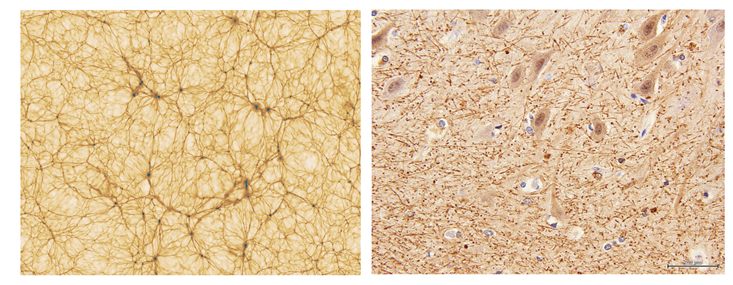
Here it is again : a comparison of the distribution of dark matter in the Universe (from numerical simulations, on the left), to a slice of the human cerebellum (right). Do these look the same to you ? Because they don't to me. Not even close. I mean, good grief. There are whacking great round lumps in the cerebellum image that aren't at all similar to anything in the simulation. The network structure of the dark matter is barely visible in the cerebellum : what paths there are are generally straighter but make sharper twists and turns. The dark matter network structure is visible because of enormous density variations which are not reflected in the brain. So :
The eye immediately grasps some similarity between images of the cosmic web and the brain.
No it fucking doesn't. This is wishful thinking writ large.
A stunning message emerges from the power spectrum graph in Figure 2 (below): The relative distribution of fluctuations in the two networks is remarkably similar, over several orders of magnitude.
A power spectrum doesn't convey the full details of the structure, any more than the standard deviation tells you about coherent formations. And the choice of features they choose to plot is completely arbitrary - it's a garbage comparison that's totally unjustified.
One of us has recently measured how difficult it is to predict how the cosmic network evolves, based on the digital evolution of a simulated universe. This estimate suggests that about 1 to 10 petabytes of data are needed to describe the evolution of the entire observable universe at the scale where its self-organization emerges (or at least of its simulated counterpart).
Whut ? I saw someone running an n-body universe simulation in realtime once. A small one, to be sure, but you don't need enormous amounts of data. It's going to be of the order of megabytes or perhaps kilobytes, not petabytes. The large scale structure emerges very naturally from gravity alone - yeah, you need much more horrendously complex physics for galaxies and stars and stuff, but not for the web. The only thing I can think they're referring to is storing the data "as is" at any step, which could be large, but you definitely don't need anything remotely like a petabyte to store something that's a much, much closer match to the structure of the brain.
It is truly a remarkable fact that the cosmic web is more similar to the human brain than it is to the interior of a galaxy; or that the neuronal network is more similar to the cosmic web than it is to the interior of a neuronal body. Despite extraordinary differences in substrate, physical mechanisms, and size, the human neuronal network and the cosmic web of galaxies, when considered with the tools of information theory, are strikingly similar. 
Does this fact tell us something profound about the physics of emergent phenomena in the two systems? Maybe. But we must take these findings with a grain of salt.
I wouldn't even call these "findings". They are nonsense statements. But suppose for the sake of argument that some similarity were to be objectively and correctly (for these are not at all the same thing) demonstrated. What would it mean ? What do you want us to do with that knowledge ? How does it change anything, knowing that the action of gravity can, under some conditions, produce something that resembles a structure produced by completely different biological processes ? In a word, so what ?

The Strange Similarity of Neuron and Galaxy Networks - Issue 74: Networks - Nautilus

Christof Koch, a leading researcher on consciousness and the human brain, has famously called the brain "the most complex object in the known universe." It's not hard to see why this might be true. With a hundred billion neurons and a hundred trillion connections, the brain is a dizzyingly complex object.

Saturday, 20 July 2019

Bystanders not just standing by

The press release below does an excellent job of completely ruining the message of a pretty good paper. You can read the paper here, it's not terribly long or difficult.

First, from the press release :
It’s one of the most enduring urban myths of all: If you get in trouble, don’t count on anyone nearby to help. Research dating back to the late 1960s documents how the great majority of people who witness crimes or violent behaviour refuse to intervene. Psychologists dubbed this non-response as the “bystander effect” — a phenomenon which has been replicated in scores of subsequent psychological studies. 
That was my naive understanding of the bystander effect too : simply that very few people will intervene in dangerous situations, and consequently that should you find yourself in trouble, it can be difficult to get people to help you. Yale's online "introduction to psychology" course suggested ways of beating this include appealing to individuals rather than groups, e.g. by calling on specific features of individuals to get them to help.

But strictly speaking the bystander effect is something different : a "phenomenon in which individuals are less likely to offer help to a victim when other people are present. The greater the number of bystanders, the less likely it is that one of them will help." This is not the same at all. If individuals are all uniformly unlikely to help, then all you need to get people to help is sheer numbers of people. If, on the other hand, it's a group effect, then this won't work - if everyone sees that everyone else is failing to intervene, then this becomes evidence that they shouldn't interfere, and thus an indefinite number of people will continuously fail to do anything.

The press release does a terrible job of conveying what the point of the study is. It does not find that individuals are actually all quite likely to intercede, which is what the text implies. The numbers quoted tell a better story :
Each event had an average of 16 bystanders and lasted slightly more than three minutes... The study finds that in nine out of 10 incidents, at least one bystander intervened, with an average of 3.8 interveners.
In other words most people (typically 75%, though we should be careful with these averages) don't intervene. The crucial detail is that in most incidents, someone does intervene, and usually more than one person. That's the key message of the paper that the authors are very explicit about :
The knowledge that an individual’s likelihood to intervene reduces in the presence of others does not establish, however, the aggregated likelihood that at least someone will help. From the perspective of the victim this remains the most important question (Latané & Nida, 1981) — will I receive help if needed? 
And so they set out to look at this from an observational perspective, using real-world CCTV data of violent incidents. They're very careful to note the limitations of their study. They looked only at incidents involving personal conflict, not emergencies like car crashes or fires. They're limited to public spaces in the inner regions of three cities, without a police presence, but in principle the footage should be a reasonably complete sample within this domain :
All data were recorded by municipality employed camera operatives, who according to identical guidelines were instructed to record all incidents of public space aggression that contained any level of conflict—from the mildest animated disagreements to grave physical violence.
So it seems at least persuasive that in incidents of this type, most people don't stop to intervene, but there's no group effect that prevents those who do wish to intervene from doing so. Consequently most incidents do receive intervention. They also note that there was no significant difference in intervention rates between the three cities examined, and that theirs is not the first study to have found that intervention rates per incident can be high.

They're careful to detail at some length the possible limitations to this study :
  • How they define "intervention", which is quite liberal - but on the other hand they don't have audio, so there may have been additional interventions that were not detectable with pure video footage.
  • The propensity of inner-city footage to favour regions of high social activities and alcohol consumption, so they can't say anything about what would happen in other conditions.
  • That their investigation is observational, not experimental.
And I would add that they don't comment on the people who didn't intervene, e.g. to try and identify any common factors that may be at work. This might be beyond the possible scope of the analysis given the quality of the CCTV footage, but it would be interesting to at least look at how many people typically walk past before someone intervenes... of the approximate 75% of people who walk on, what fraction simply don't notice, look but realise the situation is already being dealt with, and how many look and choose not to interfere ? Those fractions are also surely going to vary given the specific circumstances.

Another study on how nice people really are : they're more likely to return wallets if they contain money. Apparently the presence of cold hard cash makes people feel more like thieves than if they simply collect and empty wallet, but those numbers too vary dramatically from places to place - from 7% returned in China to 73% in Switzerland.


We should always be wary of saying that any one study refutes all the others. For example, here's an earlier study which apparently found that incident intervention rates were much lower (with the interesting angle as to whether laws actually influence moral behaviour). But I could not find any resulting paper from this. The authors of the present study finish with :
In shifting the perspective from an absence of help to an almost ever-presence, we leave behind the question of ‘why don’t individuals help?’ and explore a new avenue of enquiry asking: ‘what makes intervention successful?
But I would spin it slightly differently. I would rather ask, "under what conditions does intervention occur and what conditions reduce its occurrence ?"

Here's my sneaking suspicion as to why statistical studies sometimes find very different results : it's simply because they're not comparing things in similar contexts. Whether it be planar structures of satellite galaxies, or intervention rates in dangerous situations, a global average rate may be a nonsensical figure : there may well be no such thing as a typical case. Instead, one can only quote rates within very narrow, very carefully-defined parameters. Stating the average height of a human will get you something correct to within an order of magnitude, but it you compare only people of similar ages you'll get a very much more useful, meaningful number.

Of course this a huge, wholly unjustified extrapolation, but I don't think it's a crazy idea. Any suggestions of a "replication crisis" ought to be taken with tremendous caution : unless an experiment is an attempt at an almost identical repeat of an earlier project, it cannot really be called a replication study - and consequently each experiment explores a new part of parameter space, rather than necessarily implying that all psychology research is crap, which is a bandwagon some people are keen to jump on. I would say that if you want to state that there are problems with research, that's fine - that's the nature of research, by definition. So if you want to then go on to say, "and this means the field isn't doing its job properly", then you need to be able to explain exactly why this is any different from the normal, self-correcting-by-design approach of any scientific discipline. You might well have a point, but it's not enough to say, "this research is wrong" to conclude that "this field is poor". Mistakes in methodology are every bit as integral to the scientific process as mistaken findings.

Surveillance Cameras Show Good Samaritans Prevail Over Bystander Effect

It's one of the most enduring urban myths of all: If you get in trouble, don't count on anyone nearby to help. Research dating back to the late 1960s documents how the great majority of people who witness crimes or violent behavior refuse to intervene.

Thursday, 4 July 2019

Is the Long Peace long enough ?

Is the decrease of nation-state conflicts since WWII due to real causes, or is it simply a statistical fluke ? Stephen Pinker favours the former, others the latter. The interviewee here also generally falls into the latter camp - or rather, he seems to think that's it's just too early to tell. The problem is that if the changes after WWII really have made war less probable, at least for the West, we still haven't had long enough to tell if this is the kind of gap that might happen anyway through chance.
If you replay the statistics of the past 200 years, you would see periods of time that are as peaceful and at least as long as this long peace. This approach is what you would call a change-point analysis, because we know when we think something changed in the history of the production of wars. Can we tell a difference between the statistics on one side of that change-point from the statistics on the other side? Looking at the sizes of wars and then separately at the rate at which they’re produced, we don’t see any evidence of a change.
I think of myself as an optimist. I look at the broader set of evidence, and I see that there are reasons to believe things are changing. The pattern appears consistent with an idea that there is a trend here—that the risk of a large war among some nations is going down in part because there has not been a large war on the European continent since World War II, a clear success of efforts to promote peace. But if those efforts really are having an impact, we may not know for a long time how big that impact is.
I don't know how detailed his investigations have been because I haven't read the paper. But I wonder if it's really so valid to model the prospect of war statistically. In any given conflict there must be many different contributing factors and variable circumstances. So if any group of nations were to enact policies that made war between them less likely, that wouldn't prevent some other external nation coming along and attacking them anyway. I imagine that it might be possible to somewhat account for this, but surely there must be so many varying effects at work it would be difficult even to say if the chance of war had really gone down or not.
What makes things so interesting is that so much has changed in the world over this 200 year period. Public health. The world population. The number of nations. Technology has revolutionized everything. A wide variety of completely crazy geopolitical events have unfolded—plenty of nastiness in terms of nations becoming more autocratic along with nations being more democratic, et cetera. And yet, evidently the statistics of war have remained stable despite the changes in either direction. Why? I don’t know. I hope somebody else will look into this and tell me what the answer is.
Well, I'm again reminded of this answer on Quora which claims it's all due to age distribution. But I haven't found the original paper, so it's hard to check the details of that. It's also worth mentioning a recent study which found that non-violent protests are much more successful at regime change than violent revolutions.
The long peaces are relatively common statistical patterns under this model just because large wars are extremely rare. Because it’s fully specified, we can use that model to ask a question about the future: If that relative decrease in war were to stick around for a much larger period of time, how many more years would it need to hold before you could really say, yes, this postwar period is different from what we would expect from a stationary model where nothing’s changed. That’s where the number of 100-140 years comes out. At that point, we can then say definitively, by only looking at the severities and frequencies of wars, that the long peace is different. If you had a more sophisticated model that included information like where wars were fought, who was fighting in them, and why, et cetera, you could maybe shrink that number to some degree.
That leaves me confused as to what the analysis actually did. If it was just looking at the frequency of wars and periods of peace, then I don't think it says anything much. Surely at the very least you have to look at which nations are fighting which nations in order to account for varying local and global effects; you could at least say if the peace between Britain and France is statistically unusual or not. Otherwise I don't see that a global analysis would tell you very much. Direct link to the paper here for anyone who wants to check (I may or may not do this, time permitting).

Why Our Postwar "Long Peace" Is Fragile - Facts So Romantic - Nautilus

You could be forgiven for balking at the idea that our post-World War II reality represents a "Long Peace." The phrase, given the prevalence of violent conflict worldwide, sounds more like how Obi-wan Kenobi might describe the period "before the dark times, before the Empire."

Tuesday, 25 June 2019

Do algorithms dream of electric criminals ?

Not a terribly large amount of detail here, but interesting nonetheless.
On 73 occasions, over an eight-year-period, Ebrahimi had reported to the police that he'd been the victim of racially motivated crimes. His complaints went unheeded and a report into his murder concluded that both Bristol City Council and the police were guilty of institutional racism. "That was really a turning point from a data perspective," says Jonathan Dowey, who heads a small team of data analysts at Avon and Somerset Police. The question the force began to ask, he says, was: "Could we be smarter with our data?" 
Humans are susceptible to all manner of biases. And unlike computers, they're not good at spotting patterns - whether, for example, there have been multiple calls from the same address. When Avon and Somerset retrospectively ran a predictive model to see if the tragedy could have been averted, Ebrahimi's address popped up as one of the top 10 raising concern.
I think "not good" needs to be heavily qualified here. Under certain conditions they are absolutely astonishingly good at spotting patterns : try writing an algorithm to spot a tiger in a forest and then tell me humans aren't good at pattern recognition. True, there are plenty of cases where we screw up, but plenty where we do much, much better than an algorithm. Had the data been presented in an accessible format, it would have stood out like a sore thumb (because we're apparently very good at spotting those).
The public may be largely unaware of how algorithms are penetrating every aspect of the criminal justice system - including, for example, a role in sentencing and in determining whether prisoners get parole - but civil liberties groups are becoming increasingly alarmed. Hannah Couchman of Liberty says that "when it comes to predictive policing tools, we say that their use needs to cease".
OK, that is an absurd conclusion, but there's good reason to be skeptical :
Algorithms are informing vital decisions taken about peoples' lives. But if the computer suggests that someone is at high risk of re-offending, justice surely requires that the process by which this calculation is reached be not only accessible to humans but also open to challenge.
Shouldn't a prediction by an algorithm be treated with the same caution as a prediction by any other method ? A prediction based on correlations and extrapolations is not the same as an analytic deduction of what's going to happen next, which is what people may be confusing them with. Surely in general you respond to predictions from credible sources as though they were possible but not certain. If someone tells you that John Smith is going to murder Joe Bloggs, you keep watch, but you don't lock up Smith on those grounds alone. It would be foolish indeed to assume 100% reliability or completeness.
An even thornier issue is algorithmic bias. Algorithms are based on past data - data which has been gathered by possibly biased humans. As a result, the fear is that they might actually come to entrench bias. There are many ways in which this might occur. Suppose, for example, that one of the risk-factors weighed up in an algorithm is "gang membership". It's possible that police might interpret behaviour by white and black youths differently - and so be more likely to identify young black men as members of gangs. This discriminatory practice could then be embedded in the software.
Yes, but on the other hand, the best way of beating bias is through objective measurement. Using human judgement is hardly more likely to avoid bias than using an algorithm. An objective procedure is not the same as being objectively correct, but by defining the problem as clearly as possible, biases can be exposed much more readily than if using subjective judgement.
Which variables should go into an algorithm is hugely contentious territory. Most experts on police profiling want to exclude race. But what about sex, or age? What makes one variable inherently more biased than another? What about postcode? Durham initially included postcode in their Hart tool, but then removed it following opposition. Why should people be assessed based upon where they lived, the objection ran - would this not discriminate against people in less desirable neighbourhoods?
And there's the rub. Correlation doesn't equal causation, but statistical predictions don't care about that : they want as much data as possible. A statistically significant correlation can be absolutely meaningless. Without human oversight this is going to give ludicrous results, but equally, trying to figure out the causes of crime or predict it without data will also give nonsensical answers. And by entrenching bias against a particular demographic, there's a risk of driving that demographic toward further crime.

Perhaps a better approach would be to use this to identify areas where social policy needs to change, rather than finding areas to pre-emptively punish, and for displaying the data in different ways for humans to interpret rather than making direct predictions. We're still in the infancy of using big data to make statistical predictions, but to avoid using it, I think, would be foolish indeed. Only through rigorous examination of the data (and not our own feelings) do we have any chance of establishing which biases are justified, which have complex causes, and which are utterly false.

Could an algorithm help prevent murders?

Algorithms are increasingly used to make everyday decisions about our lives. Could they help the police reduce crime, asks David Edmonds. In July 2013, a 44-year-old man, Bijan Ebrahimi, was punched and kicked to death in south Bristol. His killer, a neighbour, then poured white spirit over his body and set it alight on grass 100 yards from his home.

Monday, 17 June 2019

Reality versus The Media

An interesting chart to be sure.

I seem to bang on quite a lot about the media being the major weak link in our (meaning the West, not America because I'm not American) socio-political system. While the media does provide some direct, unfiltered reporting of what politicians say and do, much of it also cloaks events in the veils of opinion. Any event can be twisted towards any interpretation possible. Any mistake can be seen as brazen evil. Any statement of bigotry can be seen as just and fair. Were I to have a magic wand to reform society, my first target would be without hesitation the media, not the politicians.

And yet it would be foolish to believe the media do things simply because they are bad people. That would be as pointless as the age-old complaints about the moral decline of society and how people are all just worse nowadays somehow, usually made without any justification or reasoning. While it's clear that the media get things all out of proportion, at the same time I can't help but feel that some of this is entirely natural. Not everything happens because of the network structure of society. 

In this case, dying from natural causes is certainly a hell of a lot less threatening and interesting than dying due to unnatural ones. Yes, we can all make better choices and increase our chances of living healthier for longer, but ultimately, we all gotta go sometime. And yes, stories of murder and violence sell more newspapers than telling people that an old grandma passed away peacefully in her sleep one summer's eve. But it's undeniable, I think, that stories of murder and violence do hold an innately greater fascination than those of natural causes : we don't focus on them because the news reporters are bad people, or even because they lack training in statistics to see the bigger picture, but mainly just because that's innate human nature. Any unusual event is going to attract more attention than a normal occurrence - if it wasn't in some way unusual, it wouldn't be news. The sheer abnormality of terrorism and murder means it's bound to get more attention than people dying of old age.

Of course how we deal with threats is intimately connected with how we report them, but while we shouldn't let the media off the hook for massively exaggerating the threats from terrorism and murder, neither should we ascribe them the full blame for this. Readers are interested in such events; journalists are interested in writing about them - and the papers are necessarily interested in selling papers. Magic wands aside, this isn't an easy wheel to break.


EDIT : To be clear, I mean to say not only that the skewed reporting is due to human nature, but even that there's a certain logic to it; the exaggeration of some risks isn't just because we're bad at evaluating threats (note the emphasis though). If you’re old or seriously ill, chances are you already know about it. You already have the information you need to act on and have probably already accounted for the risk factor - or equally, if you know you’re not old or seriously ill, you know you don’t need to worry about those. There’s no point in reporting them because they develop in a generally known way : continuously reporting the risk of developing cancer would just be repetitive and largely to no purpose.

In contrast, violent crimes threaten more or less everyone in an unpredictable way. In some sense, it presents an extra risk on top of the background level of risk that’s already accounted for - if a murderer is on the loose, it's much more important to be told about that immediately than it is to be informed of the health risks associated with drinking a Coke. Which is not to say that disproportionately reporting it doesn’t cause enormous problems, only that it’s not wholly without logic as well as being driven by more emotional causes.

Contrast this with my earlier stance where I compared how much more likely you are to die from drowning than terrorism. Perhaps it's not as easy as I thought to even state what a sensible risk perception is. Everyone already knows that deep water is dangerous, but people in the desert seldom stop to worry about it. Risk must be evaluated locally (both due to location and current circumstances), and reporting that accounts for that is extremely difficult. While I still broadly agree with Stephen Pinker's stance that we should see terrorism as just another hazard and not treat it as anything special* - you are after all just as dead from a heart attack as a bomb - to properly state the risk of death from different causes is highly misleading if we present only the global averages.

* Especially since terrorism only works because it causes fear and gains attention.

And finally, note how different the searches are from the media reports. Although we have to be extremely wary of interpreting what "searches" actually imply here, it would seem that the news media's influence is far from total.

Monday, 3 June 2019

Going critical

The agent-based modelling approach to the spread of ideas is, in my naive opinion, a fascinating and extremely important development. Nicky Case has an excellent website with a whole bunch of them (looks like more have been added since last I checked), in particular exploring how the structure of crowds can impede or aid the spread of ideas. It's obvious enough that the property of the idea and the pre-existing beliefs of the people are crucial. What's less obvious - or at least can be more easily and precisely revealed through simulations - is that the structure of the network is at least equally essential.

Here Keven Simler presents another excellent set of interactive simulations (Cases' are better at showing the structure, Simler's are better at demonstrating the results; Case also explores complex contagions). You should definitely run them for yourself (it's an easy and not that lengthy read), but here are some choice highlights. I thought it was particularly interesting just how versatile such network-based approaches can be - if I had to guess, I wouldn't have suspected that the spread of measles could be similar to wildfires, but apparently sometimes that expression can be an accurate metaphor.
It turns out that there's a precise tipping point that separates subcritical networks (those fated for extinction) from supercritical networks (those that are capable of neverending growth). This tipping point is called the critical threshold, and it's a pretty general feature of diffusion processes on regular networks. The exact value of the critical threshold differs between networks. What's shared is the existence of such a value.
Below the critical threshold, any finite infection on the network is guaranteed (with probability 1) to eventually go extinct. 
But above the critical threshold, it's possible (p > 0) for the infection to carry on forever, and in doing so to spread out arbitrarily far from the initial site. Note, however, that an infection on a supercritical network isn't guaranteed to go on forever. In fact, the infection will frequently fizzle out, especially in the very early steps of the simulation.
Which I suppose suggests that the timing of interference in the spread of whatever it is that's spreading can be critical, and the nature of the intervention is equally important. Simler goes on to explore one such simple intervention - the presence of nodes who are immune. Interestingly this also includes nodes which can become immune after exposure, as well as those who are temporarily afflicted but then become vulnerable again after some time.
Changing how many nodes are immune absolutely changes whether the network is sub- or supercritical. And it's not hard to see why. When many nodes are immune, each infection has fewer opportunities to spread to a new host. This turns out to have a number of very important practical implications. One is preventing the spread of wildfires... Another outbreak that's important to stop is infectious disease... Finally, we can use the concept of immune nodes to understand what happens in a nuclear reactor.
And then we look at how the connections help spread and restrict transmissions :
Up to now, our networks have been completely homogeneous. Every node looks the same as every other node. But what if we subvert this assumption and allow things to vary across the network? For example, let's try to model cities. We'll do this by creating patches of the network that are denser in connections (have higher degree) than the rest of the network. This is motivated by data that suggests that people in cities have wider social circles and more social interactions than people outside cities.
What surprises me is that some of this cultural variety can arise based on nothing more than the topology of the social network. What I learned from the simulation above is that there are ideas and cultural practices that can take root and spread in a city that simply can't spread out in the countryside. (Mathematically can't.) These are the very same ideas and the very same kinds of people. It's not that rural folks are e.g. "small-minded"; when exposed to one of these ideas, they're exactly as likely to adopt it as someone in the city. Rather, it's that the idea itself can't go viral in the countryside because there aren't as many connections along which it can spread.
Anyone want to take a stab at how this applies to political ideologies, e.g. people in the countryside seem to be more right wing and conservative ? It would be interesting to see if people who move from rural to urban areas become more liberal, and vice-versa. And networks can be intensely local as well as global, which is why behaviour among some groups can be radically different from the prevailing norms :
We tend to think that if something's a good idea, it will eventually reach everyone, and if something's a bad idea, it will fizzle out. And while that's certainly true at the extremes, in between are a bunch of ideas and practices that can only go viral in certain networks. I find this fascinating.
Cities aren't the only place we find dense networks. High schools are an interesting example. Consider, in a given neighborhood, the network that exists among the students vs. the network that exists among their parents. Same geographic area and similar population sizes, but one network is many times denser than the other. And it's no surprise, then, that fashion and linguistic trends proliferate among adolescents, and spread much slower among the adults.
 Finally we get an interesting case study of how all this can work in academia :
Suppose we distinguish two ways of practising science: Real Science vs. careerist science. Real Science is whatever habits and practices reliably produce knowledge. It's motivated by curiosity and characterised by honesty. (Feynman: "I just have to understand the world, you see.") Careerist science, in contrast, is motivated by professional ambition, and characterised by playing politics and taking scientific shortcuts. It may look and act like science, but it doesn't produce reliable knowledge. 
Of course, there's no categorical distinction between careerists and Real Scientists. We all have a little careerism in us. The question is just how much the network can carry before going quiet.
In the simulation it's fun to watch a fairly small percentage of Careerists block the successful propagation of ideas, in which one idea triggers the formation of another. I suspect there are very few scientists who are so strongly career-oriented as to be damaging for knowledge, but on the other hand it might explain why my citations are so low... :P

Though, this does make me wonder why people tend to - for example - like posts on social media but not reshare them : particularly those cases where a post gets lots of likes but few reshares. Why does this happen ? What makes something likeable but doesn't leave one with the urge to tell anyone else about it ?* I do this as much as anyone, though I do make a conscious effort to more preferentially reshare content from people I directly interact with. Content creation and dissemination seems like a major feature of social media - having conversations about the news is fine and all, but a secondary goal. (Somewhat related : people who present their own very good content but never like or reshare anyone else's. What's with that ?)

* For posts such as this one, I totally understand why people might prefer to share the original link rather than this, which is mostly my own comments.

It's also interesting to watch ideas interact with each other, though this simulation makes the assumption that successive ideas always replace the previous one. I wonder if it would be possible to model this more accurately, allowing some ideas to be replaced with others or with agents to have multiple infections independently. Or if agents could change connections depending on their current beliefs, seeking out other, similar agents and moving through the network...

It's also fun to see (though sadly you can't control) that it's not just numbers that matter but structure. If there's no key connection between two nodes that generate key ideas, then key ideas don't get started. These connection routes can be blocked with only a very few Careerists, if they're in the right places. Coherent structures, as I found out personally, don't necessarily need to be statistically significant to be important.

Going Critical

Learn how things spread with playable simulations

Review : Epic Slavic Myths

Following a now well-established procedure, after that delightful but short offering from Thames & Hudson , I turn to a longer collecti...